
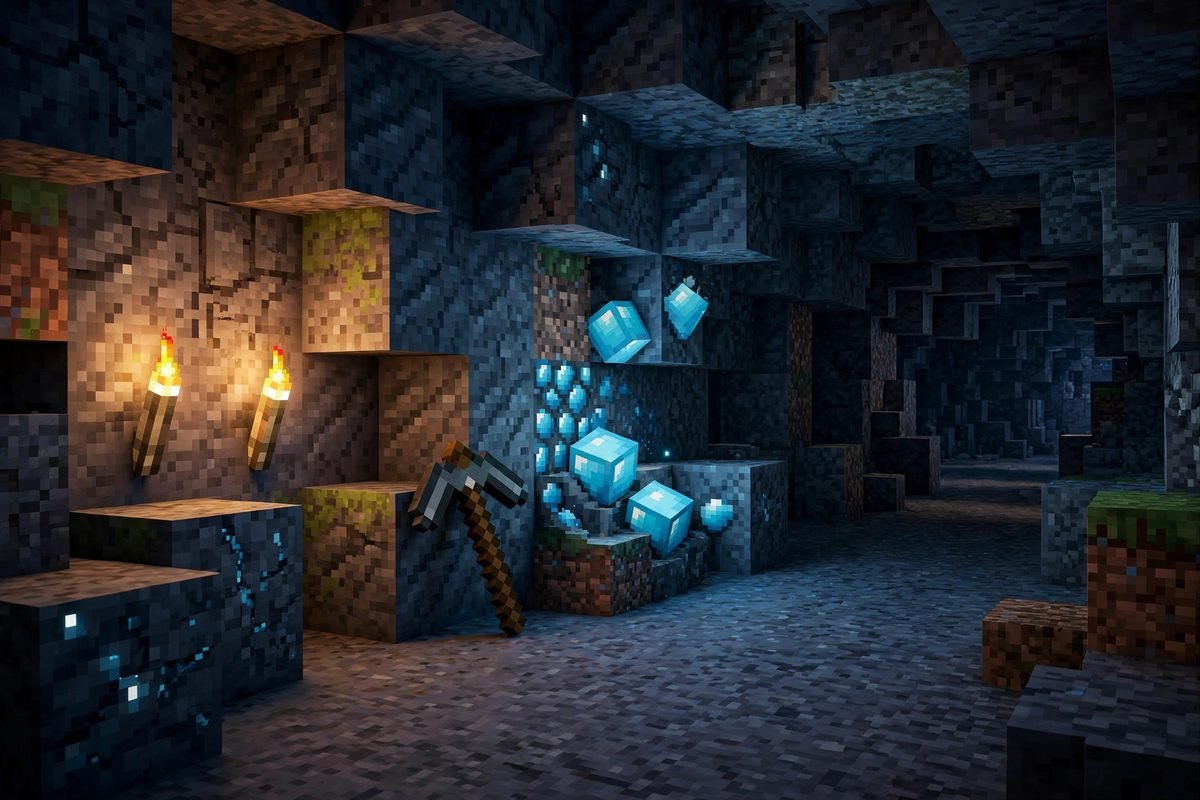
How to Find Diamonds in Minecraft: Best Y-Levels & Fastest Methods (2026)
Every Minecraft world turns on one moment: your first diamond. Knowing how to find diamonds in minecraft is mostly about knowing where the game actually puts them — because since the big cave update, diamonds follow strict generation rules that reward players who mine at the right depth, and quietly punish everyone still digging at the old levels. This guide uses the current generation rules: the best Y-levels, the strip-mining and caving methods, the trick that makes aquifers a diamond shortcut, and the Fortune maths that can more than double your haul.
Where Diamonds Actually Generate
Diamond ore generates anywhere from Y=16 down to Y=-63, and it gets steadily more common the deeper you go. But there is a catch that changed everything: reduced air exposure. When the game places a diamond ore block next to open air — a cave wall, a tunnel, the surface of a lava lake — many of those blocks are discarded before they ever appear. Depending on which generation batch the ore came from, an air-exposed diamond has a 50% chance, a 70% chance, or even a 100% chance of being deleted.
Two consequences matter for you:
- Cave walls show fewer diamonds than you would expect. The veins you see while caving are only the survivors; the majority of diamonds are buried inside solid deepslate where no cave ever touched them.
- Water and lava do not trigger the discard. Ore next to water or lava always generates, which is why flooded caves and aquifers show so many diamonds on their walls — more on that below.
According to the Minecraft Wiki’s diamond ore data, deepslate diamond ore is most commonly found at Y=-58 and Y=-59. That is the layer to build your mine around.
The Best Y-Level: -58 (and Why Not Lower)
Bedrock (the block, not the edition) starts appearing around Y=-60 and forms a jagged floor down to Y=-64. Mining at Y=-58 puts your feet two blocks above that mess: you expose the richest layer (-59 below you, -58 at your feet, -57 and -56 in the walls and ceiling) while rarely wasting time hacking through bedrock lumps.
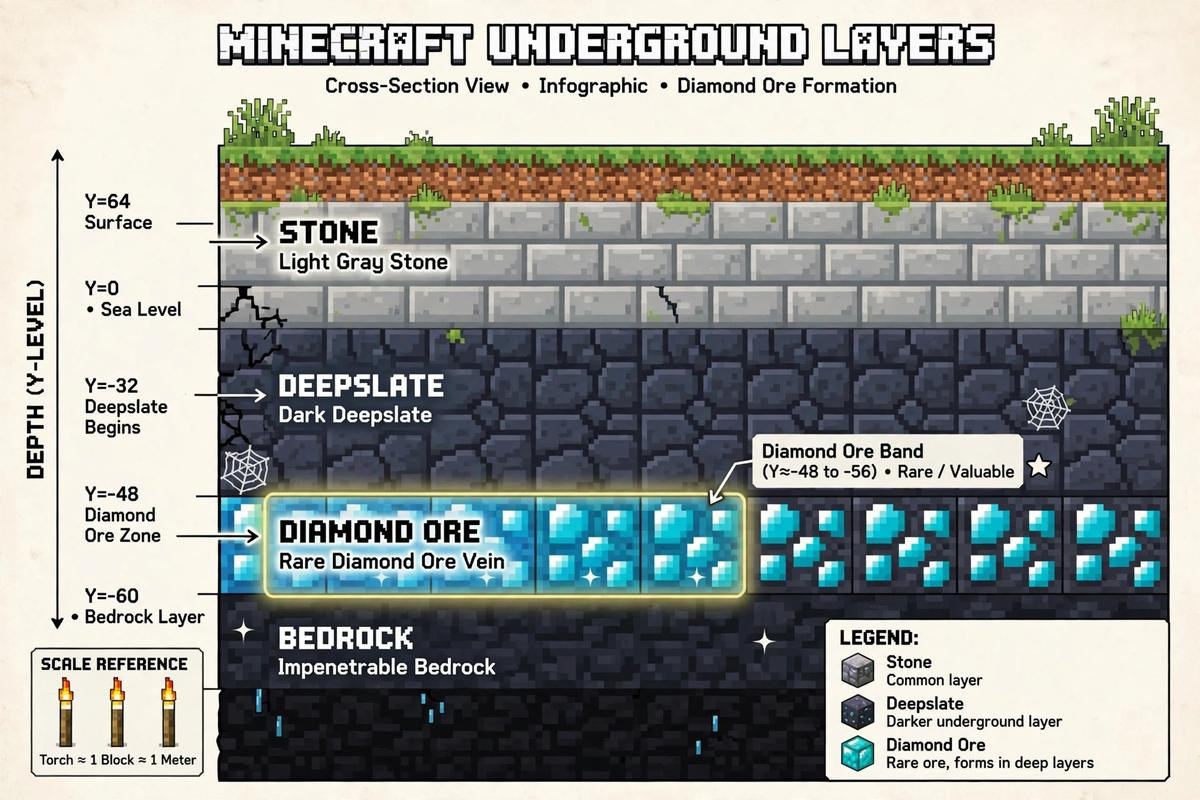
On Bedrock Edition (the game most readers play), turn on Show Coordinates in Game Settings if you have not already — your position displays on screen, and the middle number is your Y-level. You want that number to read -58 when you are standing in your tunnel. Dig a staircase or a water elevator down once, mark the spot, and every future trip is a straight ride to the diamond layer.
Before you go down, bring the right pickaxe: diamond ore only drops a diamond when mined with an iron pickaxe or better. A stone or golden pickaxe breaks the block and gives you nothing — a painful way to learn this rule inside your first vein. Each ore block drops exactly 1 diamond and 3–7 XP before enchantments.
Method 1: Strip Mining (Branch Mining) — The Reliable Way
Strip mining wins because of the air-exposure rule: since buried ore is never discarded, a tunnel network uncovers diamonds at their true, full density.

- At Y=-58, dig a long main tunnel, 2 blocks high.
- Every 3 blocks along it, dig a side branch as far as you have patience for (20–50 blocks is typical), then come back and start the next.
- Spacing branches 3 blocks apart (leaving 2 solid blocks between tunnels) means every block of deepslate is visible from at least one tunnel — almost no ore hides between your branches.
- Place torches as you go, and keep a water bucket on your hotbar: at this depth you will break into lava pockets, and deepslate tunnels love to flood from aquifers above.
It is not glamorous, and that is the point. An hour of branch mining at -58 with an Efficiency pickaxe reliably produces more diamonds than an hour of hopeful caving — and it is safe enough to do while listening to a podcast. Save the ore blocks for a Fortune pickaxe if you have one (see the maths below); mining with Silk Touch and re-mining at your base works too.
Method 2: Caving and the Aquifer Trick
Caving is faster to start and better early on, when you also need iron, gold and redstone. Drop into the biggest deepslate cave system you can find and light it up as you descend. Just remember the trade-off: exposed diamonds were partly deleted during world generation, so the pickings per hour are thinner than strip mining.
The exception is aquifers — the flooded underground lakes and water-filled cave systems. Because water contact does not discard diamond ore, aquifer walls and floors display diamonds at their full buried density, in plain sight. Bring a door or a water-breathing setup, a stack of torches or night-vision potions, and swim the walls: a single large aquifer can show several veins without you placing a single tunnel. Magma blocks at the bottom create bubble columns you can use to breathe — crouch on one to refill your air. The same “no discard next to water or lava” rule is why checking the edges of underground lava lakes is worth thirty seconds too.
One more free source at depth: fossils that generate below Y=0 sometimes have deepslate diamond ore in place of some bone blocks, so if your tunnel crosses a fossil, mine it out completely.
Method 3: Chests, Structures and Trades
Mining is not the only supply. Diamonds turn up — singly or in small stacks — in the loot chests of structures like end cities, bastion remnants, shipwrecks, buried treasure, mineshafts, ancient cities and village blacksmith buildings. None of these is farmable enough to replace mining, but an End trip or a bastion raid usually adds a few diamonds to the pile along the way.
And once your villager trading hall is running, you may barely need raw diamonds at all: armorers, toolsmiths and weaponsmiths sell enchanted diamond gear directly for emeralds, which is why many experienced players spend their mined diamonds only on a pickaxe, an enchanting table (2 diamonds) and a jukebox habit. A full set of diamond armor takes 24 diamonds; a full set of tools adds several more, so it is worth knowing your target before a long mining session. Our rare materials guide covers what to do with the other deep-cave finds, like ancient debris.
Fortune Maths: Why One Pickaxe Doubles Your Diamonds
Fortune is the highest-value enchantment in this entire process. Here is exactly what it does to a single diamond ore block, per the Minecraft Wiki:
| Pickaxe | Average diamonds per ore block |
|---|---|
| No Fortune | 1.0 |
| Fortune I | 1.33 (1/3 chance of 2) |
| Fortune II | 1.75 (25% chance each of 2 or 3) |
| Fortune III | 2.2 (20% chance each of 2, 3 or 4) |
Run the numbers on a typical session: if you come home with 20 ore blocks, that is 20 diamonds with a plain pickaxe — but an average of 44 diamonds with Fortune III. Nothing else in the game pays out like that. Two practical setups:
- Two-pickaxe system: a Silk Touch pickaxe for mining (ore blocks stack neatly and take no risk), a Fortune III pickaxe at base for breaking them.
- Fortune-first: if you are rushing, enchant a diamond pickaxe with Fortune before a long session and mine everything with it directly.
Either way, get Fortune onto a pickaxe as early as you can — our enchanting table setup guide walks through building the full 30-level setup that makes Fortune III realistic.
Staying Alive at -58
- Never dig straight down or straight up — the two oldest rules exist because lava and gravel live at this depth too.
- Water bucket on the hotbar. It puts out lava, creates obsidian paths, and breaks falls in cave drops.
- Carry torches in bulk and light every branch. A lit tunnel is a safe tunnel; an unlit one fills with creepers behind you.
- Watch the ceiling when an aquifer is near. Deepslate hides water pockets; if dripping particles appear overhead, mine that section from the side.
- Mark your way. At -58 your tunnels all look identical — leave a consistent torch side (e.g., torches always on the right wall) so you can navigate home.
Common Diamond-Hunting Mistakes
- Still mining at Y=11 or 12. That was the sweet spot in old worlds. In the current generation it is barely inside diamond territory at all — most veins generate far below you. If your mine predates the cave update, dig a new staircase down to -58.
- Breaking ore with the wrong pickaxe. Stone and golden pickaxes destroy diamond ore and drop nothing. Iron is the minimum, and if you are carrying a spare “just in case” pickaxe, make sure it is iron or better before you swing.
- Leaving a vein half-mined. Diamond veins can snake diagonally, so a block you can see often touches one you cannot. Always excavate the blocks immediately around a find before moving on.
- Skipping dirt and gravel patches. Underground dirt and gravel blobs cut through deepslate and can conceal ore behind them. When your tunnel crosses a soft patch at diamond depth, it is worth a few seconds to clear it out and check the deepslate behind it — some of the best “lucky” veins are simply hidden ones.
- Mining without spare torches or food. At Y=-58 you are at least a minute from the surface on a good day. Running out of either turns a routine trip home into a survival problem.
Frequently Asked Questions
What is the single best Y-level for diamonds?
Y=-58, with Y=-59 equally rich. The wiki’s distribution data puts the peak of deepslate diamond ore at those two layers, and -58 keeps you clear of most bedrock.
Do diamonds spawn above Y=0?
Yes, diamond ore generates from Y=16 downward, but it is rare up high and gets more common with depth. Above Y=0 you are mostly in stone, and nearly every vein is small. Go deep.
Fortune or Silk Touch — which pickaxe should I use?
Both, for different jobs: Silk Touch to collect ore blocks safely and stack them, Fortune III to break them for an average of 2.2 diamonds each. If you can only have one, take Fortune.
Why do I find so few diamonds on cave walls?
Because of reduced air exposure: diamond ore that would have generated next to open air is often deleted during world generation (up to 100% for one generation batch). Buried ore is unaffected, which is why strip mining outperforms caving — and why aquifer walls, where the discard does not apply, look so rich.
How many diamonds do I need for a full set of gear?
24 for a complete armor set (helmet 5, chestplate 8, leggings 7, boots 4). A pickaxe costs 3, a sword 2, and an enchanting table 2 — so roughly 30 diamonds covers the essentials, which is about 14 ore blocks mined with Fortune III.
Conclusion
Mine at Y=-58, branch every 3 blocks, swim your aquifers, and never break an ore block without Fortune if you can help it. That is the whole secret — the current generation rules reward depth and patience, not luck. For more mining-era know-how, browse our tips and tricks page, and if you are still setting up your world on mobile, our Pocket Edition guide covers getting started safely.