Minecraft Villager Trading: Best Trades, Professions & Discounts (2026)
Emeralds are the closest thing Minecraft has to money, and minecraft villager trading is how you earn and spend them. Set up properly, villagers will sell you enchanted diamond armor, Mending books, ender pearls and explorer maps — and happily buy the sticks, crops and rotten flesh you would otherwise throw away. This guide covers all 13 professions and their job site blocks, the trades actually worth your time, and the discount mechanics (including the Bedrock rules that differ from Java) so you never overpay again.
How Trading Works
Every trade uses emeralds on one side. You either sell a villager items they want (crops, coal, string) for emeralds, or spend emeralds on what they sell. One catch: each trade can only be used a limited number of times before the villager is “sold out” of it. Villagers restock up to twice per in-game day when they can reach their job site block — and on Bedrock Edition, a villager must also be linked to a bed to restock. No bed link, no restock: that is the number one reason Bedrock trading halls “stop working.”
Villagers level up as you trade with them, through five ranks:
| Level | Badge | Villager XP needed |
|---|---|---|
| Novice | Stone | 0 |
| Apprentice | Iron | 10 |
| Journeyman | Gold | 70 |
| Expert | Emerald | 150 |
| Master | Diamond | 250 |
Higher levels unlock better trades. On Bedrock, each level unlocks up to three trade slots, and a villager ends up with 7–10 trades in total. A brand-new villager without a job is called unemployed until it claims a job site block — and green-robed nitwits can never take a job or trade at all.
All 13 Professions, Job Blocks and Best Trades
Place the job site block next to an unemployed villager and it takes the matching profession. This is the complete list:
| Profession | Job site block | Best known for |
|---|---|---|
| Armorer | Blast furnace | Enchanted diamond armor at Expert/Master; buys coal, iron and even diamonds |
| Butcher | Smoker | Buys raw meat and sweet berries; sells cooked food cheaply |
| Cartographer | Cartography table | Ocean monument and woodland mansion explorer maps; the only source of the globe banner pattern |
| Cleric | Brewing stand | Buys rotten flesh and gold; sells ender pearls and Bottles o’ Enchanting |
| Farmer | Composter | Buys wheat, carrots, potatoes and beetroot; Master sells golden carrots and glistering melon slices |
| Fisherman | Barrel | Buys string, coal and fish; sells enchanted fishing rods and campfires |
| Fletcher | Fletching table | Buys 32 sticks for 1 emerald at Novice — the easiest emerald in the game; sells bows, crossbows and tipped arrows |
| Leatherworker | Cauldron | Buys leather and rabbit hide; Master sells a saddle |
| Librarian | Lectern | Enchanted books — including Mending; Master sells name tags |
| Mason | Stonecutter | Buys clay and stone variants; Master sells quartz blocks and pillars |
| Shepherd | Loom | Buys wool and dyes; sells shears and paintings |
| Toolsmith | Smithing table | Buys coal, iron and diamonds; sells enchanted diamond tools |
| Weaponsmith | Grindstone | Buys coal, iron and diamonds; Master sells enchanted diamond swords and axes |
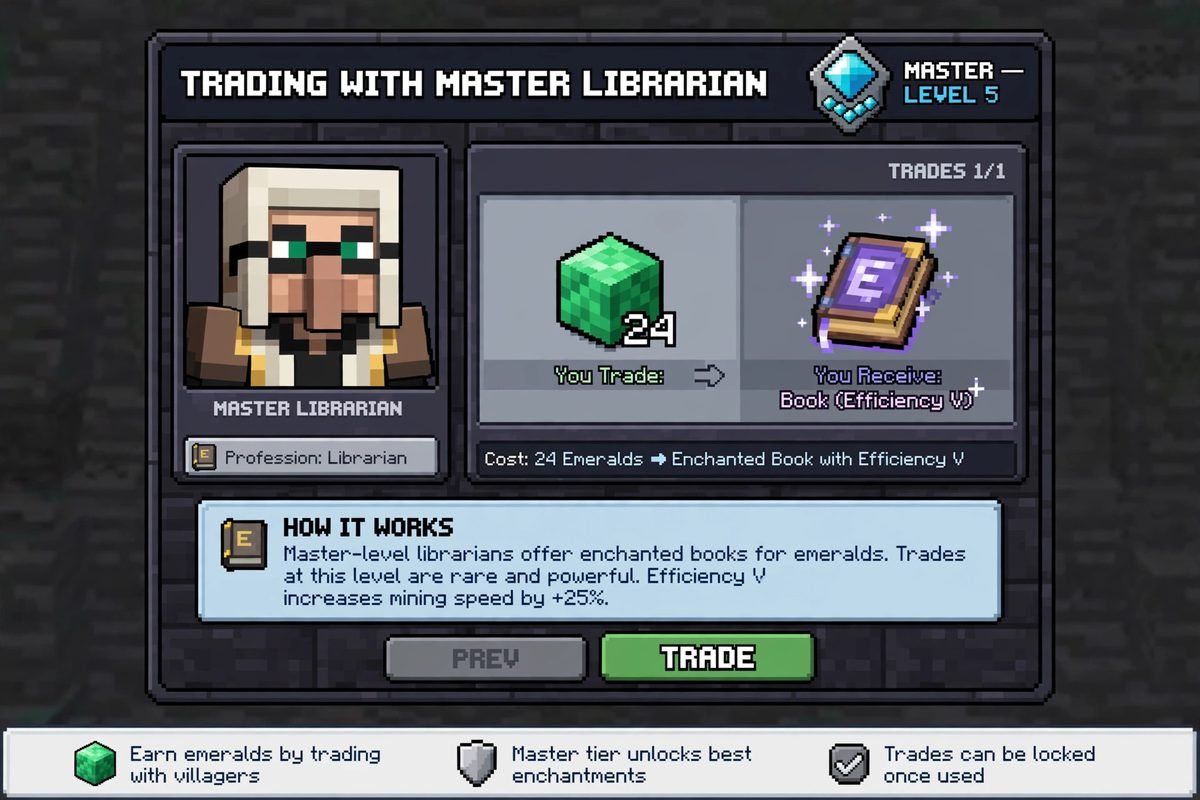
A few stand out. The librarian is the single most valuable villager in the game: any librarian’s first enchanted-book trade can be any enchantment, including treasure-only ones like Mending that you cannot get from an enchanting table. The armorer sells enchanted diamond leggings and boots at Expert (roughly 13–33 emeralds) and helmets and chestplates at Master — often cheaper than mining the diamonds yourself, especially with the discounts below. Clerics quietly solve two annoying farms at once: they buy the rotten flesh zombies drop anyway, and sell ender pearls for your portal and End trips.
Locking In Trades (and Re-Rolling Bad Ones)
Here is the rule that makes trading halls possible: a villager that has never been traded with can still change profession. If you remove its job site block, it becomes unemployed again, and placing a new block gives it a new profession with completely new trades.
That means you can re-roll a librarian’s first enchanted book as many times as you like: place a lectern, check the book, and if it is not the one you want, break the lectern and place it again. The moment you complete even one trade, however, the villager’s profession and trades lock in permanently — it will keep them even if the job site block is destroyed. So always check the full offer before your first trade, and never “test trade” a villager you might want to re-roll.
The Best Ways to Earn Emeralds
You need emeralds coming in before you can spend them. The most reliable earners, roughly in order of effort:
- Fletcher + sticks. 32 sticks for 1 emerald, restockable twice a day. A few stacks of logs becomes a steady emerald income with zero setup.
- Farmer + crops. A modest wheat, carrot or potato farm feeds a farmer’s buy trades forever. Master farmers also sell golden carrots — the best food in the game — so the profession pays you twice.
- Fisherman + string. If you have a spider farm or a mineshaft nearby, string converts straight into emeralds.
- Mason + clay/stone. Clay balls from riverbeds and dripstone-era stone variants sell well, and the mason’s higher tiers buy the stone types you mine anyway.
- Librarian + paper. Sugar cane becomes paper, paper becomes emeralds — a classic, fully renewable loop.
- Armorer/Toolsmith/Weaponsmith + coal and iron. Your mining leftovers fund the very villagers who will sell you diamond gear.
Never sell your actual diamonds to these villagers for 1 emerald each unless you are swimming in them — that trade exists, and it is a terrible deal. Diamonds are worth far more as gear; see our rare materials guide for what else they can do.
Discounts: Curing and Hero of the Village
Base prices are just the starting point. Three forces move them:
Curing a zombie villager gives the biggest single discount. A villager you personally cure offers you a large, permanent discount — and smaller discounts spread to villagers within about 16 blocks of the cured one. One important, often-misreported rule: curing the same villager more than once gives no extra discount. Older Java guides describe zombifying and re-curing the same villager repeatedly to stack prices down to 1 emerald; that stacking does not keep growing — each villager grants its curing discount once. Plan on one cure per villager.
Hero of the Village, earned by winning a raid, cuts all prices by 30% at level I, rising by 6.25% per extra level to a 55% cut at level V. It stacks with curing discounts, and prices can never fall below 1 item.
Demand pushes the other way: buy out the same trade repeatedly and its price creeps up until the villager restocks and demand settles. And one Bedrock mercy: on Java, attacking or killing villagers raises your prices through bad reputation — on Bedrock, negative reputation never increases prices at all, so an accidental punch is far less costly on mobile.
How to Zombify and Cure, Step by Step
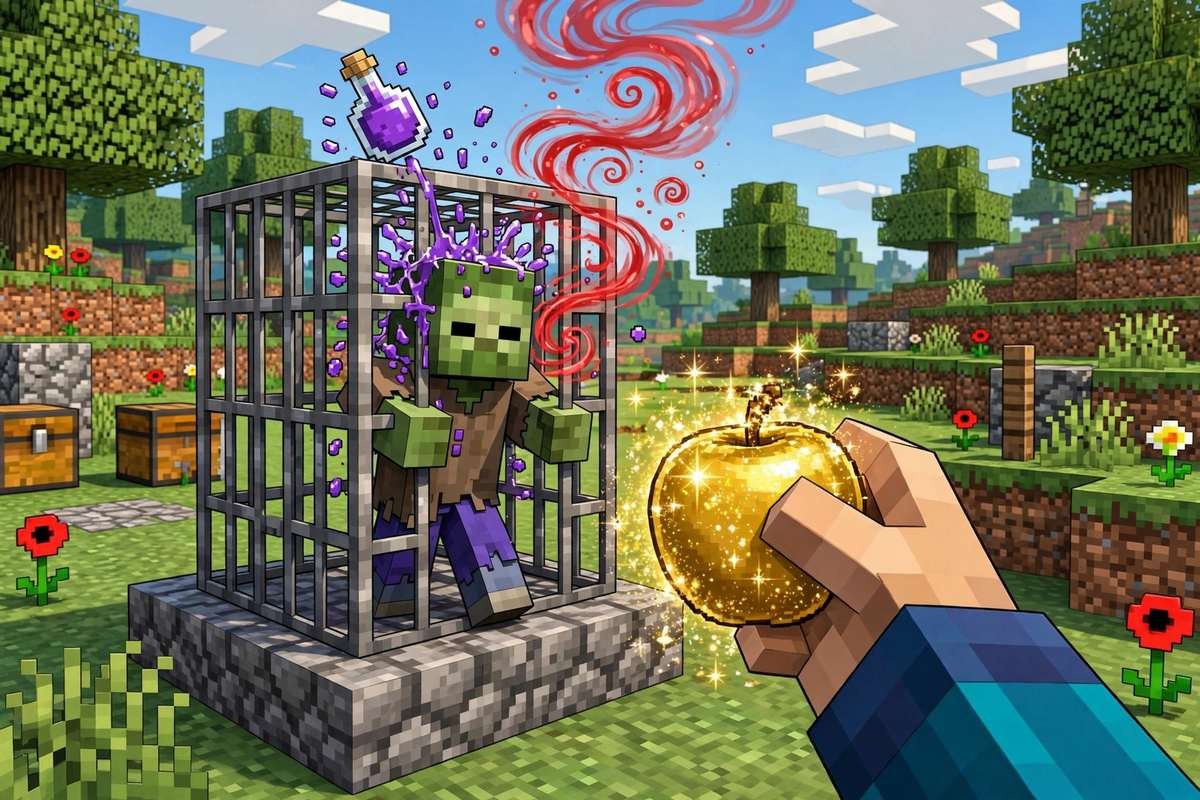
- Set up the conversion. When a zombie kills a villager, the villager’s chance of becoming a zombie villager instead of dying is 0% on Easy, 50% on Normal and 100% on Hard. For a deliberate zombify-and-cure, briefly play on Hard (or accept the 50% coin flip on Normal). On Easy it can never work, so do not waste golden apples there.
- Trap both. Lure a zombie to the villager in a small enclosed space, let it do the work, then trap the zombie villager (a 1×2 hole, boat or minecart works) and deal with the zombie.
- Splash weakness. Throw a splash potion of weakness at the zombie villager. (Weakness is the one potion that needs no nether wart — just a fermented spider eye in a water bottle.)
- Feed a golden apple. Use a normal (not enchanted) golden apple on it. It will start shuddering — curing has begun.
- Wait 3–5 minutes. The cure timer is random between 3 and 5 minutes. Iron bars or a bed placed within a few blocks of the cell speed it up slightly. Keep the area safe and lit — the patient is still a zombie, and it gains Strength while curing, so keep your distance.
- Done. The villager reappears with its old profession and trades intact (if it had traded before), plus your permanent discount. On Bedrock, zombified villagers never despawn, so you can cure them whenever you are ready.
Building a Simple Trading Hall
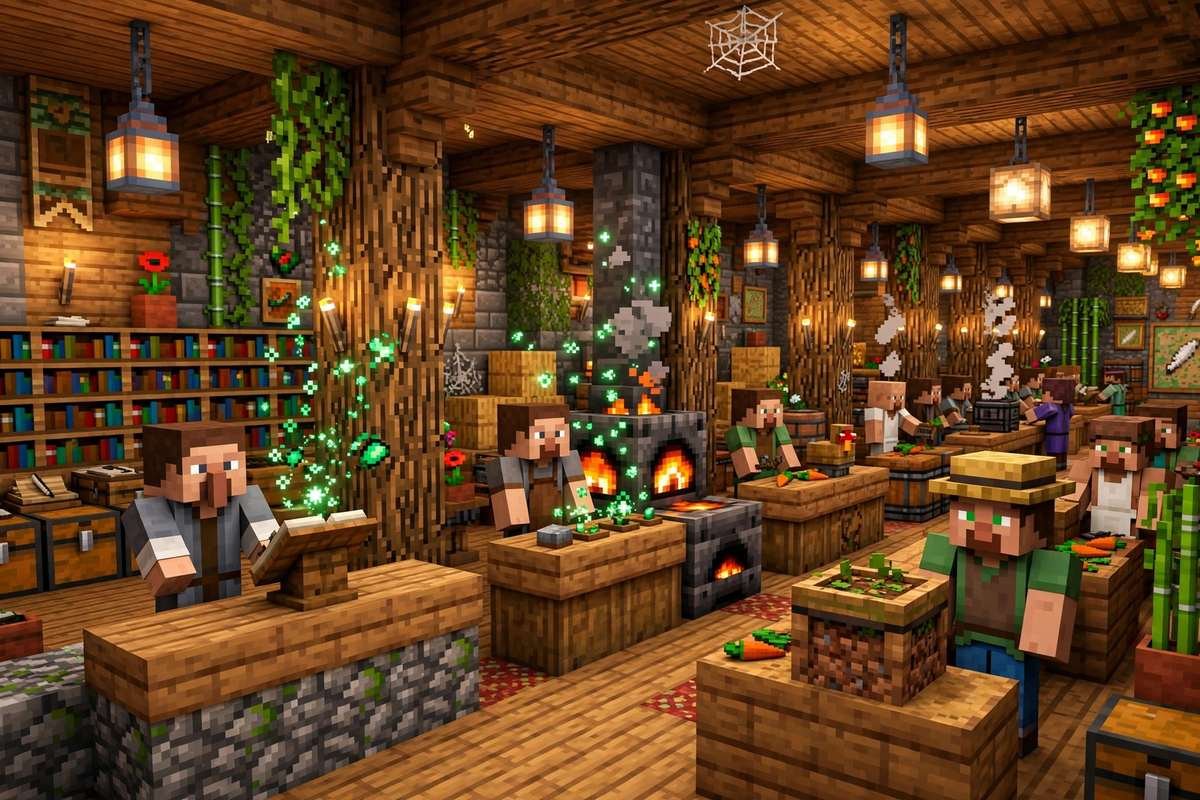
You do not need a mega-build. A row of 1×1 cells works: each cell holds one villager, its job site block within reach, and — on Bedrock — a bed it can link to (beds can sit under the floor or behind the cells; the villager just needs to claim one). Light everything, seal the roof against zombies and phantoms, and give yourself a “staff entrance” with the job blocks accessible so you can re-roll untraded villagers. For your first night and early-game priorities before all this, our first night survival guide has you covered.
Frequently Asked Questions
How do I get a Mending book from a villager?
Any librarian’s Novice enchanted-book trade is random and can be Mending. If it is not, break and replace the lectern to re-roll — as long as you have not traded with that librarian yet. Once you see Mending, trade once immediately to lock it in.
Why won’t my villager restock on Bedrock?
Almost always one of two things: the villager cannot reach its job site block during its work hours, or it is not linked to a bed. Bedrock villagers must claim a bed to restock, even if they never sleep in it. Give every trader an accessible bed and a reachable workstation.
Do curing discounts stack if I cure the same villager five times?
No. A villager grants its curing discount once; further cures add nothing. Cure each villager once, and combine that with Hero of the Village for the deepest prices.
Can a nitwit learn a profession?
No. Villagers in green robes (nitwits) can never take a job or trade. Interestingly, if a nitwit is zombified and then cured on Bedrock, it comes back as a normal unemployed villager that can take a job.
How do I change a villager’s trades?
Only before the first trade. Remove the job site block, let the villager become unemployed, then place a block again for fresh trades (or a different block for a different profession). After any completed trade, profession and trades are locked forever.
Conclusion
Start with a fletcher for easy emeralds, a librarian you re-roll until it offers the book you want, and a farmer to turn crops into cash. Cure each villager once for the permanent discount, keep beds and job blocks in reach so restocking never stalls, and your trading hall will supply enchanted diamond gear, Mending books and ender pearls for the rest of the world. For the exact trade tables and price multipliers, the Minecraft Wiki’s trading page is the reference this guide follows.