
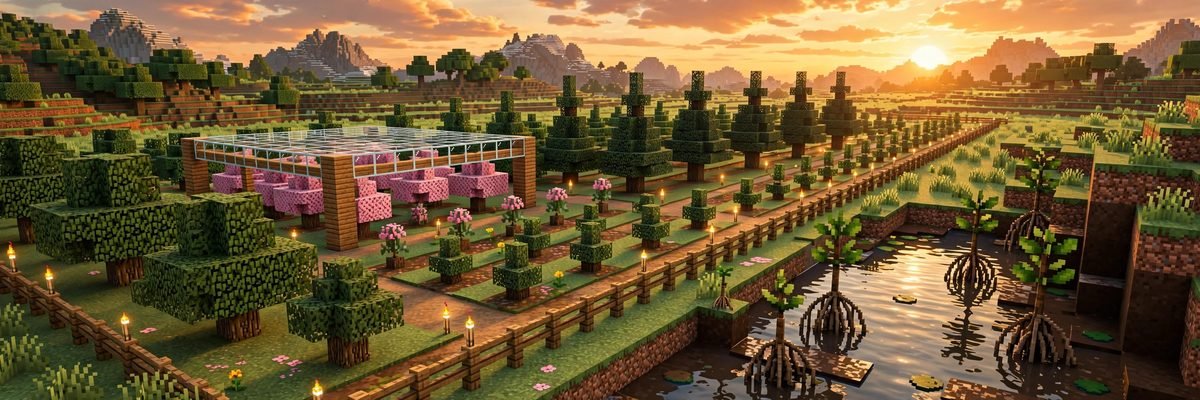
Minecraft Tree Farming: How to Grow Every Tree Type Fast
Wood is the one resource you never stop needing — for tools, builds, charcoal, scaffolding and a hundred recipes in between. A well-planned minecraft tree farm turns that endless chore into a five-minute harvest: plant, grow, chop, replant. The catch is that every tree species plays by slightly different rules. Give a dark oak a single sapling and it will sit there forever. This guide covers the growth rules for every tree type in current Bedrock (the 26.x line), the clear space each one needs, how bone meal really works, and a simple farm layout for phone players.
Whether you are punching your first oak on day one (our first-night survival guide covers that stage) or setting up a permanent wood supply, this is the complete tree-growing reference.
How Tree Growth Actually Works
Every sapling has two invisible growth stages to pass before a final “growth check” turns it into a tree. Three conditions control whether that check can succeed:
- Light. The block above the sapling needs light level 9 or higher for its growth stage to advance naturally. Sunlight gives 15, but torches work just as well — trees need light, not the sun.
- Space. When a tree tries to grow, the game picks a tree shape and checks whether the required volume above the sapling is clear. If a block is in the way, that attempt fails and it waits for the next one. Each species needs a different amount of clear space — the table in the next section lists them all.
- A valid block underneath. Saplings grow on dirt, grass, podzol, coarse dirt and moss (not dirt paths). Mangrove propagules also accept mud and clay, and can grow underwater.
Bone meal changes the maths but not the rules: it forces an immediate growth attempt and works even without enough light, but the space check still applies — which is why “my tree won’t grow” is almost always a spacing problem, not a bone meal problem.
One Bedrock note: trees only grow in loaded, ticking chunks, so stay within simulation distance of your farm — wander off mining for an hour and your saplings will be exactly as you left them.
The Space Every Tree Needs (Bedrock)
These are the minimum clear spaces above the planting spot, from the Minecraft Wiki’s sapling page:
| Tree | Planting pattern | Minimum clear space above | Column |
|---|---|---|---|
| Oak | 1 sapling | 5 blocks | 3×3 |
| Jungle | 1 sapling | 5 blocks | 3×3 |
| Birch | 1 sapling | 6 blocks | 3×3 |
| Spruce | 1 sapling | 6 blocks | 5×5 |
| Acacia | 1 sapling | 6 blocks | 5×5 |
| Mangrove | 1 propagule | 6 blocks | plus room for roots (see below) |
| Dark Oak | 4 saplings (2×2) | 7 blocks | 6×6 in Bedrock |
| Pale Oak | 4 saplings (2×2) | 7 blocks | 6×6 in Bedrock |
| Cherry | 1 sapling | 8 blocks | 5×5 |
| Mega Spruce | 4 saplings (2×2) | 14 blocks | 6×6 in Bedrock |
| Mega Jungle | 4 saplings (2×2) | 11 blocks | 6×6 in Bedrock |
The 2×2 giants also need clear ground around them in Bedrock: a clear 4×4 area centred on a mega spruce’s saplings, and a clear 3×3 around (and north-west of) a mega jungle’s.
Every Tree Type, Species by Species
Oak and Fancy Oak
The beginner’s tree, and still the most forgiving: one sapling, just 5 clear blocks above it in a 3×3 column. Oak occasionally grows as a “fancy” oak — a taller, branching variant with a rounder canopy — and if a block sits inside the growth space (but not directly above the sapling), the tree is forced toward that large variant; a modest ceiling (see the layout section) keeps them short instead. Oak and dark oak leaves can also drop apples.
Birch
Birch needs 6 clear blocks in a 3×3 column and always grows straight up — no branches, no surprise canopy, every log in one line for fast chopping. That predictability is why birch is a farm favourite.
Spruce and Mega Spruce
A single spruce sapling needs 6 clear blocks in a wider 5×5 column. Plant four in a 2×2 square — with 14 blocks of clearance and a clear 4×4 patch at ground level — and you get a mega spruce or mega pine, up to roughly 30 blocks tall and the most logs per harvest of any tree. Harvesting a giant means pillaring or scaffolding up it, so most players farm single spruce daily and save giants for big projects.
Jungle and Mega Jungle
A lone jungle sapling behaves like oak (5 clear blocks, 3×3 column) and sometimes grows with vines and cocoa pods. The 2×2 mega jungle needs 11 clear blocks and rewards you with one of the largest canopies in the game. Jungle leaves drop saplings at half the normal rate (see below), so keep a reserve.
Acacia
Acacia needs 6 clear blocks in a 5×5 column because of its signature shape: a leaning, splitting trunk topped by a flat umbrella canopy. That sideways spread makes acacia awkward in tight farm rows — give it its own corner plot.
Dark Oak and Pale Oak
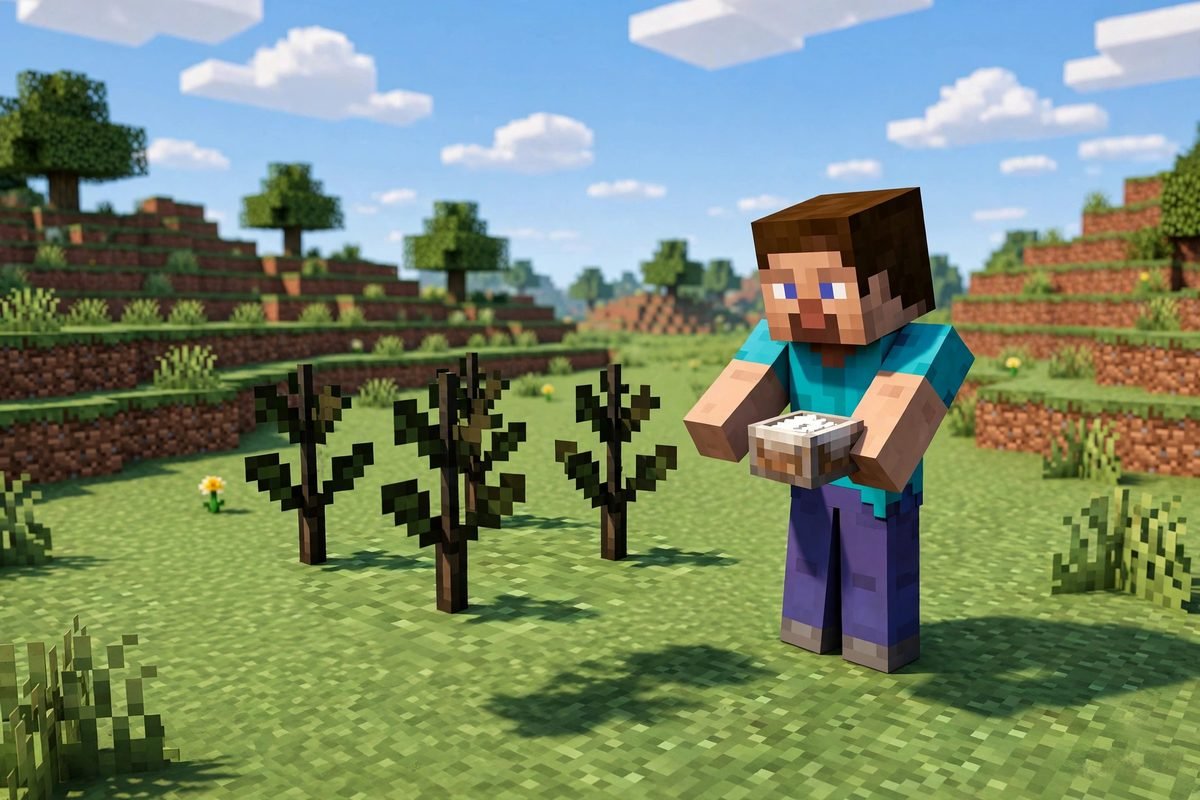
These two only grow from four saplings in a 2×2 square — a single dark oak or pale oak sapling never grows, the single most common tree-farming mistake. Give the square 7 clear blocks above it (a 6×6 column in Bedrock). Dark oak is the farmer’s favourite giant: fast-growing, lots of logs per plot, apples from its leaves. Pale oak is its pale-garden counterpart, with the same rules and a ghost-white wood set. Both species’ home biomes are covered in our best Minecraft biomes guide.
Cherry
Cherry trees are the divas of the farm: 8 clear blocks above the sapling in a 5×5 column — the most headroom of any single-sapling tree — because the canopy spreads wide and dome-like. Bonus: oak, birch and cherry saplings planted within 2 blocks of a flower have a 5% chance to grow with a bee nest (2–3 bees inside).
Mangrove
Mangroves break several rules: they grow not from saplings but from propagules, the green pods hanging under mangrove leaves in mangrove swamps. Only fully grown hanging propagules drop as items when broken; bone meal on mangrove leaves (with space underneath) starts one, and more bone meal ages it. A hanging propagule never becomes a tree where it hangs; you must plant it.
Planted propagules accept dirt, moss, mud and clay, need at least 6 empty blocks above, and can even grow underwater. The complexity is below ground: roots spread up to 5 blocks sideways and need solid blocks to land on beneath — the deeper those blocks are, the more attempts the tree needs, and mud does not count as a landing block. So plant on flat mud at the edge of shallow water; a propagule over deep, empty water often fails. Dirt above a propagule does not block growth (logs and wood do, in Bedrock), and a grown mangrove has a 1% chance to generate a bee nest, flowers or not.
Azalea and Flowering Azalea
Azalea bushes (found on moss in lush caves, renewable by bone-mealing moss) never grow on their own. Bone meal is the only way: each use gives an azalea or flowering azalea a 45% chance to become an azalea tree, provided a 3×5×3 space above it is clear (leaves and logs excepted). The result is an oak-shaped tree whose canopy mixes azalea leaves and, from a flowering bush, flowering azalea leaves — plus rooted dirt under the trunk and hanging roots below. Wild azalea trees also mark lush caves: they generate above them. Azalea leaves drop azalea bushes at the usual 5% rate, so one tree restocks your supply.
Poplar
The newest addition: poplar saplings grow into orange, yellow or red poplar trees — autumn-coloured variants following the standard single-sapling rules. Their exact clearance is not yet documented on the Minecraft Wiki, so give them generous headroom — treat them like cherry.
How to Get Saplings for Every Tree
Your farm is only renewable if each harvest restocks your saplings:
- Leaves drop saplings at 5% when they decay or are broken without shears or Silk Touch; jungle leaves are the exception at 2.5%.
- Fortune helps. A Fortune III tool raises the drop rate to 10% (4.17% for jungle). Worth setting up an enchanting table early if wood is your main material.
- Wandering traders sell any sapling — including mangrove propagules — for 5 emeralds each: the fastest way to import a species your spawn is far from.
- Compost the spares. Each excess sapling in a composter has a 30% chance to raise the compost level; a full stack converts to an average of about 2.74 bone meal, feeding straight back into the next batch.
A Simple Tree Farm Layout That Works on Mobile
You do not need redstone to farm wood efficiently. This manual layout is what we run on Bedrock mobile:
- Flatten a plot of grass or dirt near your base, within simulation distance.
- Plant in rows with a walking gap between them, and keep species separated: birch and single spruce in the fast rows, 2×2 plots for dark oak, a pond-edge strip for mangroves.
- Add a ceiling for the short rows. A glass roof about 7 blocks up lets small oaks and birch through but blocks taller variants, so every log stays in reach — no pillaring, no floating canopies. Use glass, not logs: in Bedrock a log or wood block above a sapling counts as an obstruction, while glass lets light through.
- Light the plot with torches so the space above every sapling stays at light level 9+ after dark — growth then continues all night.
- Harvest the whole trunk, let the leaves decay (they drop saplings and apples as they go), collect the drops, and replant.
Bone Meal: Faster Trees on Demand
When a build needs wood now, bone meal is the accelerator. Remember how it works: a sapling has two growth stages, and each bone meal use forces one growth attempt with a chance to advance it — expect to spend a few bone meal per tree, and the full space requirements still apply. Azalea is the documented exception with a flat 45% chance per use to become a tree outright.
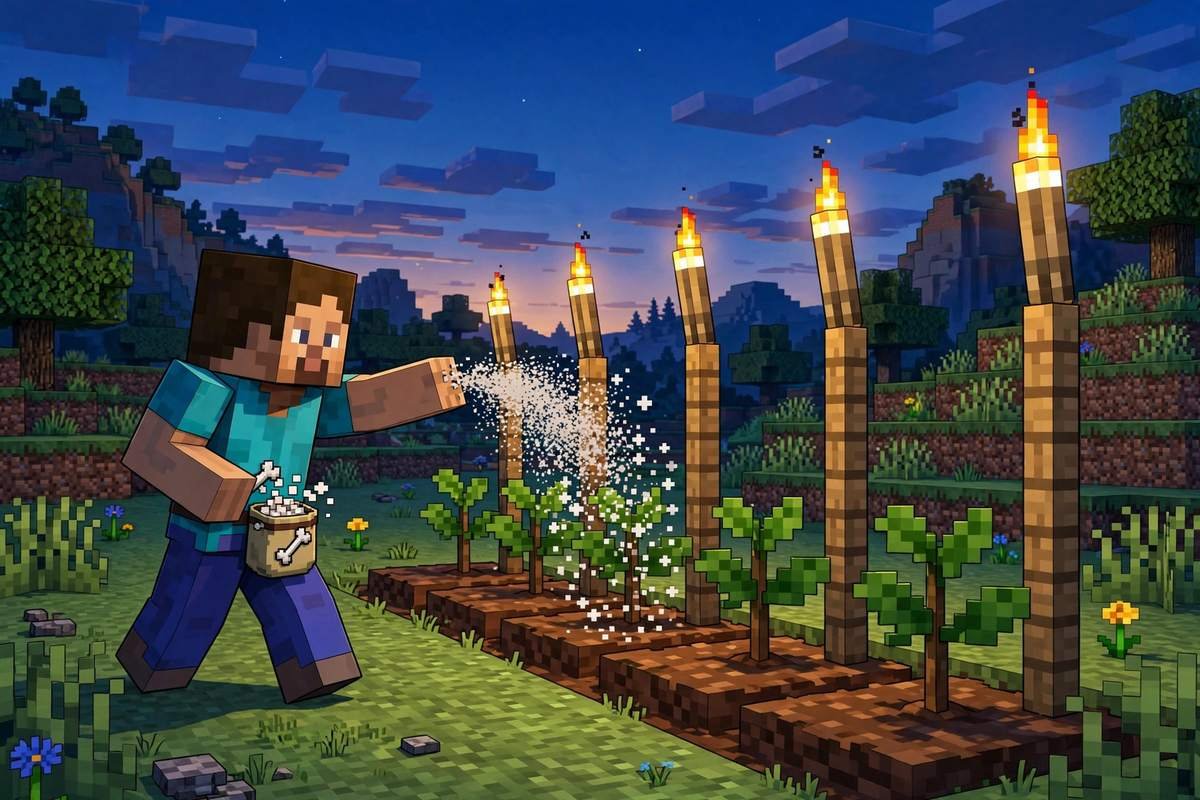
Supply matters more than technique: skeleton bones are the classic source, a composter loop (previous section) recycles surplus saplings, and bone blocks from fossils or the Nether’s soul sand valleys craft into 9 bone meal each. Keep a stack in a chest by the farm, and replanting day becomes: plant row, bone meal row, chop row.
Troubleshooting: Why Your Tree Won’t Grow
Work through this checklist in order — one of these is almost always the cause:
- Single dark oak or pale oak sapling? It will never grow — these species require a 2×2 square of four (see the table above).
- Not enough clearance? Compare your space against the table above. Cherry under a 6-block ceiling and mega spruce under a farm roof are classic failures.
- Something in the column. In Bedrock, logs and wood above the sapling block growth — and the 2×2 giants also fail if the ground-level area around their saplings is cluttered.
- Too dark. Below light level 9 above the sapling, natural growth stalls. Bone meal forces attempts anyway, but torches are cheaper.
- Wrong floor. Saplings will not grow on dirt paths. Mangroves additionally fail when their roots have no solid blocks to land on below — plant over shallow, flat ground.
- Hanging propagule. A propagule still hanging under leaves cannot grow into a tree — harvest it fully grown and plant it.
- Too far away. Growth happens on random ticks in loaded chunks. If you are outside simulation distance, nothing grows.
One last tip from our tips and tricks page: saplings also grow in the Nether and the End — just bring Overworld dirt, light and space with you.
Frequently Asked Questions
How long does a tree take to grow in Minecraft?
There is no fixed timer. A sapling advances through two growth stages on random ticks, then needs a successful space check — so a tree in open ground with good light typically grows within several minutes, while a cramped one takes far longer. Bone meal skips most of the wait.
Why won’t my dark oak tree grow from one sapling?
Because dark oak (and pale oak) can only grow from four saplings planted in a 2×2 square, with at least 7 clear blocks above them in Bedrock. A single sapling of these species will stay a sapling forever.
Can trees grow underground or in the dark?
Underground, yes — trees need a light level of 9 or above over the sapling, not sunlight, and torches provide it. In complete darkness saplings will not advance naturally, though bone meal can still force attempts.
Which tree is best for a wood farm?
For effortless daily wood, dark oak: fast-growing, lots of logs per 2×2 plot, apples from its leaves. For the biggest single harvests, mega spruce and mega jungle give the most logs per tree but take longer to strip. Birch is the tidiest option — fast, predictable, branch-free trunks.
Do trees regrow after I chop them down?
No — logs and leaves never regrow. The farm works because decaying leaves drop fresh saplings: collect, replant, and compost the spares into bone meal.
Conclusion
A reliable minecraft tree farm is three habits: give every species the clearance it needs (and a 2×2 square where required), keep light at 9 or higher above your saplings, and run a compost loop so bone meal is always on hand. Start with birch and dark oak for painless daily wood, add a mangrove strip on mud, and save the mega spruce for a project that deserves a 30-block giant.
Growth requirements follow the Minecraft Wiki, Bedrock figures where editions differ.




One Comment