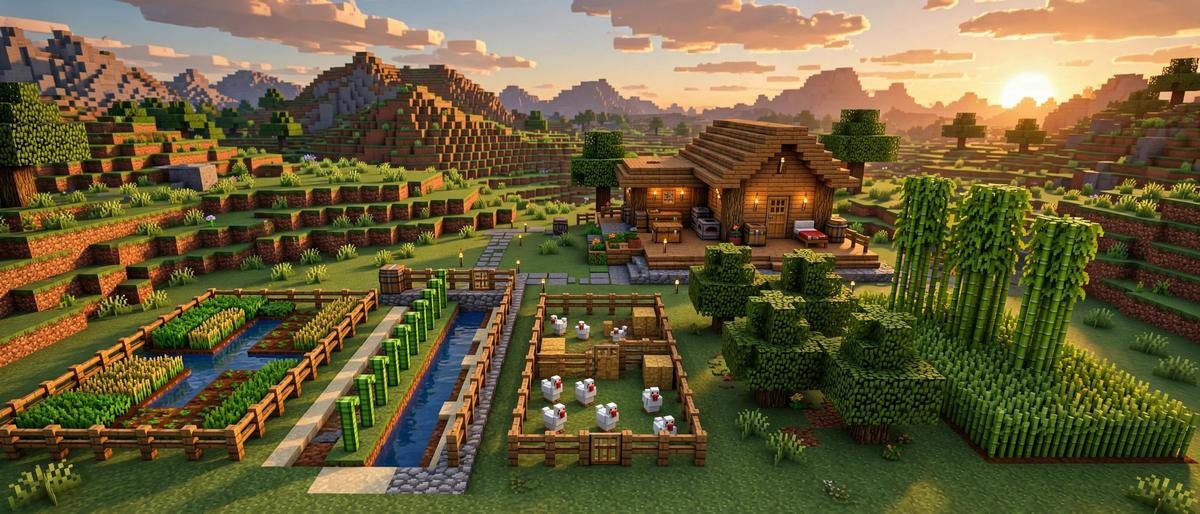
5 Best Minecraft Starter Farms Every Beginner Should Build First
Every long-term Minecraft world runs on farms. The castle, the enchanting room, the trip to the End — all of it is powered by reliable supplies of food, wood and fuel, and players who build their minecraft starter farms early never have to stop mid-project to go hunting for dinner.
The five farms in this guide were chosen for beginners: each one costs only basic materials, needs no rare redstone knowledge, works on Bedrock (phone, console, Windows) and Java, and pays for itself the day you build it. Build them in order, near your base — farms only produce while their chunks are loaded, so a farm ten minutes away is mostly switched off.
Farm 1: The 9×9 Crop Farm (Food That Never Runs Out)
What it gives you: wheat for bread and animal breeding, plus carrots and potatoes — the food backbone of your whole world.
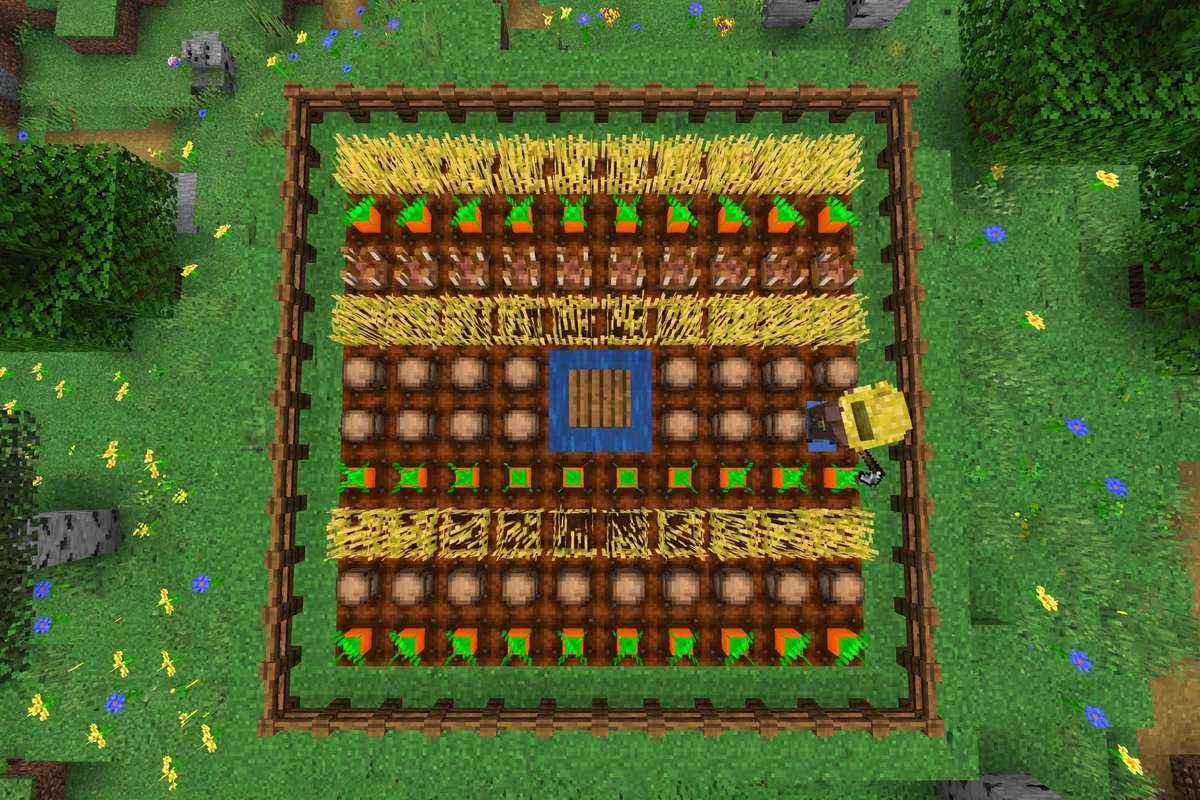
One water block hydrates farmland up to four blocks away in every direction, which makes the perfect starter plot a 9×9 square with a single water source in the middle: 80 blocks of fully watered farmland from one bucket.
Materials:
| Item | Amount | Notes |
|---|---|---|
| Dirt (or grass) blocks | 81 | A 9×9 patch |
| Water bucket | 1 | 3 iron ingots for the bucket |
| Hoe | 1 | Any tier — wood works |
| Seeds, carrots, potatoes | As many as you have | Start with whatever you’ve found |
| Slab or trapdoor | 1 | Covers the water so you don’t fall in |
| Fence + gate (optional) | ~36 + 1 | Keeps animals and creepers out |
| Torches | 4+ | Crops need light level 9 or more to grow |
Build steps:
- Flatten a 9×9 area near your base and place a water block in the exact center.
- Till all 80 surrounding blocks with your hoe. The farmland turns dark as it hydrates.
- Cover the water with a slab or trapdoor — the water still hydrates through it, and you can walk across.
- Plant in alternating rows: a row of wheat, a row of carrots, a row of potatoes. The game grows crops faster when a row sits next to a different crop or empty farmland, so mixed rows genuinely beat one big block of wheat.
- Ring it with torches and fence it if you can.
How well it pays: wheat, carrots and potatoes each grow through eight stages; on hydrated farmland in good light, a wheat crop is typically ready in a little over a day-night cycle. Each mature wheat drops 1 wheat plus on average just under 3 seeds back, so the farm replants itself forever, and bone meal (which advances a crop 2–5 stages per use) covers emergencies. Harvest whenever you pass by and one 9×9 feeds a player comfortably, with surplus wheat for breeding animals.
The farmer upgrade: place a composter next to the plot and let an unemployed villager claim it. A farmer harvests mature crops and replants from their own inventory during work hours, even bone-meals crops from the composter, and uses harvested wheat to craft bread shared with other villagers. A farmer won’t collect food for you — you still pick up the drops — but the replanting labor disappears.
Farm 2: Sugar Cane Rows (Paper, Sugar and Rocket Money)
What it gives you: paper for maps, books and — later — firework rockets; sugar for cake and potions. This farm funds your endgame.
Sugar cane only grows on dirt, grass, sand or similar blocks directly beside water, and each stalk tops out at three blocks tall.
Materials (for a 12-stalk starter row):
| Item | Amount |
|---|---|
| Sugar cane | 12 (every stalk you can find) |
| Sand or dirt | 12 |
| Water | A 12-block trench, still or flowing |
| Slabs (optional) | 12, laid over the water to walk on |
Build steps:
- Dig a straight trench and fill it with water (an infinite water source — a 2×2 pool — and a bucket make this painless).
- Line one or both edges of the trench with sand or dirt.
- Plant one sugar cane on each block, right against the water.
- Harvest by breaking the middle and top blocks only. Leave the bottom block standing and the stalk regrows — break the bottom and you have to replant.
How well it pays: cane is patient — on average roughly one new block per stalk every 18 minutes on Java, and slower still on Bedrock (roughly one block per 54 minutes) — so output comes from stalk count, not speed. Plant every wild stalk you find and lengthen the row as you grow. One Bedrock bonus Java players don’t get: on Bedrock, bone meal works on sugar cane and grows it instantly to full height, perfect when you need paper now. A mature 24-stalk farm gives you a stack of cane every few harvests — paper for bookshelves and your first rockets, forever.
Farm 3: The Simple Chicken Cooker (Cooked Food on Autopilot)
What it gives you: cooked chicken and feathers automatically, plus eggs as a by-product.
The design has two halves. On top, adult chickens stand on hoppers: every chicken in a loaded chunk lays an egg every 5–10 minutes, and the hoppers catch them. Below, a dispenser fires those eggs into a tiny chick chamber — some thrown eggs hatch chicks — and chicks grow up in exactly 20 minutes. An adult is tall enough that its head reaches a lava layer held one block above the chicks’ heads, so the moment one grows up it is cooked, and a hopper floor pulls the cooked chicken and feathers into a chest.

Materials (compact version):
| Item | Amount | Notes |
|---|---|---|
| Hoppers | 3–5 | The expensive part: 5 iron each — save up |
| Dispenser | 1 | 7 cobblestone, 3 string, 3 sticks, 1 redstone |
| Redstone dust + repeater or observer | A few | For a simple repeating clock |
| Lava bucket | 1 | The cooking element |
| Glass or solid blocks | ~20 | Chamber walls you can see through |
| Chest | 1–2 | Collection |
| Chickens | 8–16 to start | Lure with seeds, or hatch from eggs |
Read the cautions before you build — this is where beginners lose everything:
- Test it in a Creative copy first. Redstone timing and dispenser behavior differ between Bedrock and Java, and most video tutorials are recorded on Java. Build small, watch one full cycle, then trust it.
- Drops burn if they touch lava. The kill chamber floor must be hoppers, so cooked chicken falls straight through to the chest instead of sitting in the fire.
- Keep your chicken count modest. Dozens of chickens in one chunk means lag on mobile and constant clucking. Sixteen layers up top is plenty.
- No Java tricks. Bedrock has no entity-cramming rule, so designs that kill by overcrowding simply don’t work the same way — the lava-at-head-height method above is the Bedrock-reliable approach.
- Simpler is fine. A fenced pen of chickens bred with seeds, harvested by hand — plus a cow pen bred with wheat, for leather and beef — gets you most of the benefit with zero redstone. Animal handling is covered in our animal taming guide.
Farm 4: The Tree Patch (Wood, Charcoal and Apples)
What it gives you: endless wood, sticks, charcoal fuel and the occasional apple — and it costs nothing but saplings.
A “farm” here can be low-tech: a flat patch where you plant saplings in a grid, grow them, chop them down and replant from the saplings the leaves drop.
Materials: saplings (start with 8–12 oak), an axe, bone meal for impatient days, torches.
Build steps and rules:
- Plant saplings with space around each one — trees refuse to grow if the space above and beside them is blocked, and the block above a sapling needs strong light (level 9 or more) for growth to tick.
- Give the patch a clear sky or good torch light so growth never pauses.
- Chop the whole trunk, let the leaves decay, and collect the fallen saplings — you usually get back more than you planted, so the patch slowly expands itself.
- Smelt spare logs into charcoal: it smelts 8 items per piece, exactly as good as coal, so this patch doubles as your first renewable fuel supply.
How well it pays: a small oak patch you harvest whenever you pass keeps a starter base in wood permanently. When you outgrow it, our full tree farming guide covers every species’ exact spacing, mega trees and a proper farm layout.
Farm 5: The Bamboo Grove (The Fastest Thing You’ll Ever Plant)
What it gives you: sticks, scaffolding, bamboo wood and emergency fuel — from the fastest-growing plant in the game.
Find your first bamboo in a jungle biome, in shipwreck or jungle temple chests, or as junk while fishing in jungle waters. From a single stalk, you can grow a forest.
Materials: bamboo (even 1 to start, 8–16 is better), a patch of dirt, grass, sand or mud, and that’s it — bamboo needs no water at all.
Build steps:
- Plant stalks in a row or small grid on any dirt-like block.
- Make sure the top of each growing stalk has light level 9 or above.
- Harvest like sugar cane: break the second block up, and everything above it falls while the bottom block regrows.
How well it pays: bamboo grows fast — a stalk adds a block roughly every three and a half minutes on average and tops out at 12–16 blocks tall, so a 16-stalk grove produces armfuls per harvest. Two bamboo craft into a stick, six bamboo plus one string make six scaffolding (the best temporary climbing block in the game), and bamboo burns as fuel — weakly, at four pieces per item smelted, so treat fuel as a backup use. Its real job is sticks and scaffolding forever.
Bonus: Your Sixth Farm Should Be Kelp
Once these five are running, add kelp at the edge of any pond or ocean: plant it underwater and it grows toward the surface, anywhere from 2 to 26 blocks tall, needing no light at all. Break the plant and the drops float up to you. Smelt kelp into dried kelp — a snack and prime fuel stock: nine dried kelp craft into a dried kelp block that smelts 20 items, one of the best renewable fuels in the game, and smelting the kelp pays a little XP too. The Minecraft Wiki’s farmland guide covers Farm 1’s hydration rules in full.
Troubleshooting: Why Isn’t My Farm Producing?
| Problem | Likely cause | Fix |
|---|---|---|
| Crops planted but never grow | Light below 9, or farmland dried out | Add torches; keep water within 4 blocks |
| Farmland keeps turning back to dirt | Something (or someone) is jumping on it | Fence the plot; walk the paths, not the crops |
| Sugar cane won’t grow taller | It’s at its 3-block cap, or not beside water | Harvest the top two blocks; check water adjacency |
| Cooker chest is empty | Chunks unloaded, or the clock isn’t firing | Stay near your base; test the dispenser circuit by hand |
| Bamboo stopped growing | Top of the stalk is in shadow | Raise light at the top of the grove to 9+ |
| Nothing grows while I’m away exploring | Farms only tick in loaded chunks | Keep starter farms at your base |
New players hit most of these in week one; our first night survival guide and tips and tricks page cover the rest of the early game, and all five farms run happily on the Pocket Edition version too.
Frequently Asked Questions
What is the best first farm to build in Minecraft?
The 9×9 crop farm. It costs one bucket, one hoe and a patch of dirt, and it removes food stress from the game permanently — wheat for bread and breeding, carrots and potatoes as reliable meals. Every other farm here builds on that security.
Do farms work while I’m away from my base?
Only in loaded chunks. On Bedrock, crops, bamboo, sugar cane and egg-laying tick only while the farm’s area is loaded — in practice, while you or another player are nearby. That’s why all five belong right at your base, not at a distant outpost.
Which starter farm makes the best fuel?
The tree patch, early on: charcoal from logs is a renewable fuel that smelts 8 items per piece, identical to coal. Later, kelp overtakes it — one dried kelp block smelts 20 items, and kelp grows fast underwater with no light at all.
Why do Java farm tutorials sometimes fail on Bedrock?
Because some mechanics differ: Bedrock has no entity-cramming rule, dispenser and redstone timing can behave differently, and a few growth tricks (like bone meal on sugar cane) work on Bedrock but not Java. Always test a copied design in Creative first, and prefer the simplest version of any farm.
Can a farmer villager run my crop farm for me?
Mostly. A farmer with a composter harvests mature wheat, carrots and potatoes and replants from their own inventory, and will even bone meal crops. What they won’t do is hand you the harvest — drops are shared between villagers or picked up by you or a hopper — so the farmer is free labor, not a vending machine.
Conclusion
Five small farms — a 9×9 crop plot, a sugar cane row, a cautious chicken cooker, a tree patch and a bamboo grove — turn a shaky first base into a self-feeding one: food, wood, charcoal, sticks and scaffolding sorted, and paper stockpiling for the rockets and books ahead. Build them at your base, keep them simple, and test anything with redstone before you trust it.