Rare Materials in Minecraft Complete Guide (2026)
Rare materials in Minecraft are the key to enchanting, trading and building the best gear.. If you’re still digging around Y 40 expecting diamond ore, you’re working far above the main diamond range. Rare materials in Minecraft are not limited to ores, either: some of the hardest-to-obtain resources come from mobs, generated structures, treasure chests, or progression milestones.
This guide covers where the main rare ores and items come from, the tools or methods required to obtain them, and the common mistakes that waste time. It starts with mineable ores, then moves to rare items obtained from mobs, structures, treasure, and special loot.
“Rare materials” is used broadly here to include difficult-to-find ores, progression items, mob drops, structure loot, and a few valuable items or enchantments that players commonly hunt during long-term Survival worlds.
Why Rare Materials Matter
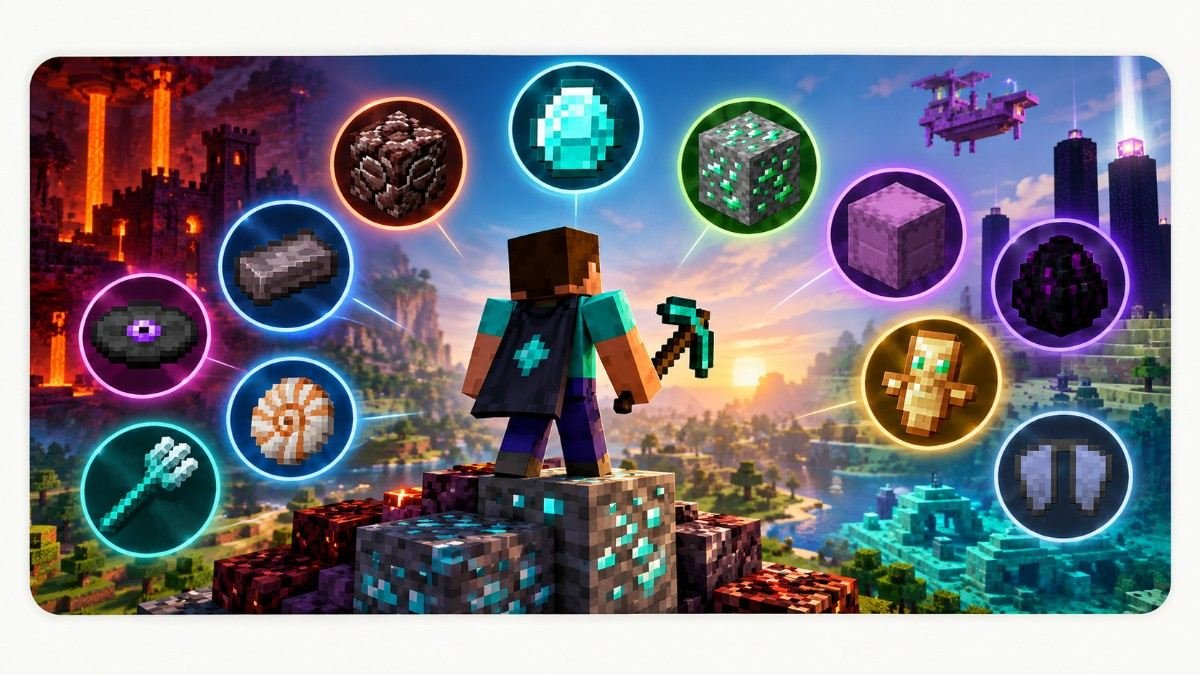
Rare materials are more than simple upgrades. Diamond is an important step toward advanced tools and equipment, while ancient debris is the starting point for obtaining netherite. Other rare finds serve completely different purposes.
A Totem of Undying can save a player from an otherwise fatal hit. A dragon egg is primarily a trophy. An elytra provides a completely different form of movement, while a shulker shell opens the door to portable storage through shulker boxes.
That variety is what makes rare-material hunting useful. Some items improve progression, some unlock crafting recipes, and others are valuable simply because of how difficult they are to obtain.
Quick Reference: Rare Ores by Y-Level
| Ore | Y-Level Range | Peak / Common Level | Tool Needed | Main Note |
|---|---|---|---|---|
| Diamond | -64 to 16 | Around Y -59 | Iron pickaxe or better | One of the main deep-mining targets |
| Redstone | -64 to 16 | Around Y -59 | Iron pickaxe or better | Generates in the same general depth range as diamond |
| Ancient Debris | 8 to 119 in the Nether | Around Y 15–16 | Diamond or netherite pickaxe | Main source of netherite scrap |
| Emerald | -16 to 320 in mountain biomes | Around Y 232 | Iron pickaxe or better | Strongly tied to mountain biome generation |
| Lapis Lazuli | -64 to 64 | Around Y 0 | Stone pickaxe or better | Important for enchanting and other crafting uses |
| Nether Quartz | Throughout the Nether | No single main Y-level | Any pickaxe | Common Nether resource rather than a depth-specific ore |
Part 1: Rare Ores You Mine
Diamond
Diamond ore generates from Y -64 through Y 16, with its highest concentration around Y -59.
An iron pickaxe or better is required to successfully obtain diamond ore. A stone pickaxe is not enough to drop the diamond.
For traditional branch mining, Y -59 is a useful target because it places you in the strongest part of the diamond distribution. Natural caves at similar depths can also expose diamond ore without requiring long tunnels.
Diamonds are used for diamond tools, armor and several important crafting recipes. They also form part of the progression toward netherite equipment.
Emerald
Emerald ore is unusual because its generation is strongly tied to mountain and windswept-hills-type biomes.
It generates between Y -16 and Y 320 and is most common around Y 232. Emerald ore can appear in small blobs, so even when you’re in the correct biome, finding large exposed veins is not something to expect.
For most Survival players, emeralds are more useful as a villager-trading currency than as a mining resource. Emerald ore is therefore less important to actively mine than diamond or ancient debris unless you’re specifically collecting it or playing in an area where mountain terrain exposes it naturally.
An iron pickaxe or better is required to obtain emerald ore.
Ancient Debris and Netherite
Ancient debris generates only in the Nether. It can occur from Y 8 through Y 119, with the highest concentration generally described around Y 15–16.
Ancient debris is especially useful because it can survive explosions that destroy many surrounding blocks. This is one reason explosive mining methods are sometimes used to expose larger areas of Nether terrain.
You need a diamond or netherite pickaxe to obtain it.
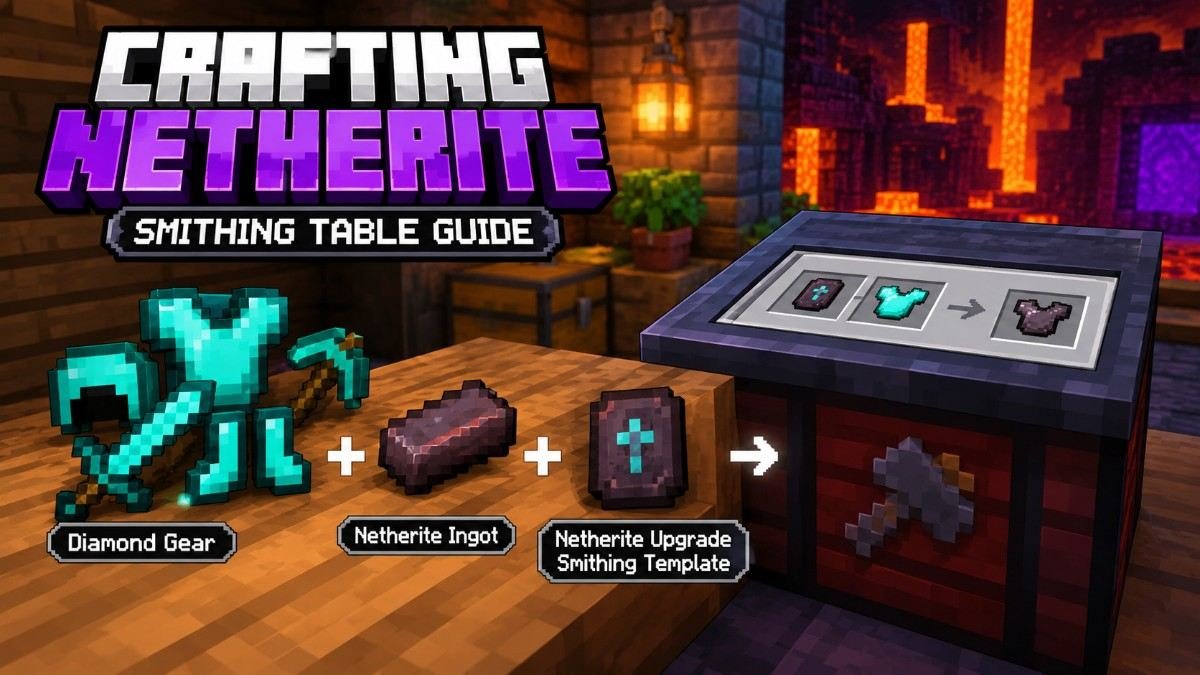
Once collected, ancient debris can be smelted into netherite scrap. Four netherite scraps combined with four gold ingots produce one netherite ingot.
To upgrade diamond equipment to netherite, the current system uses a Smithing Table, a netherite upgrade smithing template, the diamond item, and a netherite ingot. The upgrade is not performed in a furnace or by combining the materials directly in a crafting table.
Ancient debris can also be found as loot in some bastion remnant chests, so mining is not its only source.
Lapis Lazuli, Redstone, and Quartz
Lapis lazuli generates between Y -64 and Y 64 and is most common around Y 0. A stone pickaxe or better can mine it successfully.
Redstone ore generates between Y -64 and Y 16 and is most common around Y -59. It requires an iron pickaxe or better.
Nether quartz ore generates throughout the Nether rather than being restricted to a narrow Y-level. It is an important ingredient for several redstone and building-related recipes, so it is worth collecting during Nether exploration.
Part 2: Rare Items You Can’t Just Mine
Not every rare Minecraft resource has a Y-level.
Some of the most difficult items come from mobs, structures, treasure chests, or progression milestones. These items require a completely different approach from ordinary mining.
Totem of Undying
The Totem of Undying comes from evokers.
Evokers can be encountered in woodland mansions and during raids. When an evoker is killed, it drops a Totem of Undying.
The totem must be held in either hand to activate when the player would otherwise die. It then applies its survival effects and consumes the totem.
Because the drop from an evoker is guaranteed, Looting does not increase the chance of receiving the totem.
Dragon Egg
The dragon egg is a unique End-game trophy.
In Java Edition, the first Ender Dragon defeat produces one dragon egg on top of the exit portal. Defeating the respawned dragon does not produce another egg in Java Edition.
Bedrock Edition differs: the dragon egg can be obtained twice by defeating the Ender Dragon twice.
The egg cannot normally be mined like an ordinary block. Attempting to break it causes it to teleport. A piston can push it, or the egg can be made to fall onto a block such as a torch or slab so that it drops as an item.

Echo Shards and the Recovery Compass
Echo shards are obtained from chests in Ancient Cities.
They are used to craft a recovery compass. A recovery compass uses eight echo shards around a normal compass.
The recovery compass is designed to point toward the location of the player’s most recent death, making it useful when returning to a dangerous area after losing items.
Ancient Cities are located in the Deep Dark, so collecting echo shards is not simply a matter of mining at one exact Y-level. If you’re entering an Ancient City for the first time, our guide on surviving the Warden and exploring the Deep Dark can help you prepare. Exploration and careful movement are part of the process.
Enchanted Golden Apple
The Enchanted Golden Apple is different from the regular Golden Apple.
A regular Golden Apple can be crafted. An Enchanted Golden Apple cannot normally be crafted in Survival mode and is obtained through special loot sources instead.
Enchanted Golden Apples can appear in several generated structures, including Ancient Cities and certain Trial Chamber loot. Their availability has expanded over time, but they remain a special loot item rather than a normal crafting recipe.
This distinction matters because many older guides simply call both items “golden apples” and leave readers with the wrong impression.
Elytra
Elytra are found in End Ships, which generate alongside some End Cities in the outer End islands.
They cannot be crafted.
Finding an elytra therefore requires End exploration after reaching the outer islands. The item is one of the major long-term exploration rewards because it provides gliding-based aerial movement.
Wither Skeleton Skull
Wither Skeleton Skulls come from Wither Skeletons, which naturally spawn in Nether Fortresses.
The normal drop chance is low, making three skulls a significant collection target for players who want to summon the Wither.
Looting can improve the drop chance.
Three Wither Skeleton Skulls are required along with soul sand or soul soil to construct the Wither. Defeating the Wither then provides a Nether Star.
Beacon (Nether Star)
A beacon requires a Nether Star, which is obtained by defeating the Wither.
The beacon itself is then activated by placing it above a suitable pyramid made from blocks such as iron, gold, emerald, diamond or netherite.
Once active, a beacon can provide useful area effects such as Speed, Haste, Resistance, Jump Boost and Strength, depending on the selected configuration.
Trident and Nautilus Shell
Tridents and nautilus shells are both associated with drowned, but their mechanics differ between editions.
In Java Edition, about 6.25% of naturally spawned drowned carry a trident, and a player-killed trident-holding drowned has an 8.5% chance to drop it. Looting can raise the drop chance, reaching 11.5% with Looting III.
In Bedrock Edition, naturally spawned drowned have a different trident-holding and drop system, so Java percentages should not be copied into a Bedrock guide.
Nautilus shells also have edition-specific drowned mechanics. In Java Edition, some naturally spawned drowned carry a nautilus shell, while Bedrock has different spawning rules. Nautilus shells can also be obtained through fishing and wandering-trader trades.
Eight nautilus shells combined with one Heart of the Sea are used to craft a conduit.Once you have the required materials, follow our guide to build and activate a conduit for underwater exploration.
Resin Clumps
Resin is associated with the Pale Garden and the Creaking.
When the relevant Creaking mechanics are active, resin can appear on nearby Pale Oak trees. Resin clumps can then be used for resin-related crafting, including resin bricks.
This material is more closely connected to the Pale Garden’s unique mechanics than to conventional ore mining.For more information about the biome and its unique mechanics, see our guide to the Pale Garden biome.
Shulker Shell
Shulker shells come from shulkers, which are found in End Cities and End Ships.
In Java Edition, a shulker has a 50% base chance to drop one shell, with Looting III raising the chance to 68.75%.
Bedrock Edition uses different shulker drop mechanics, so Java’s exact percentage should not be presented as a universal rate.
Two shulker shells plus one chest are used to craft a shulker box. Because shulker boxes retain their contents when broken, they are among the most useful storage items for long-term worlds.
Heart of the Sea
The Heart of the Sea is obtained from buried treasure chests.
Every buried treasure chest contains one Heart of the Sea, making the main challenge finding the buried treasure rather than getting a random drop from the chest.
Buried treasure maps can be found through certain generated structures such as shipwrecks and underwater ruins. Once you reach the marked treasure location and open the chest, the Heart of the Sea is guaranteed.
Eight nautilus shells plus one Heart of the Sea are required to craft a conduit.
Rare Music Discs
Music discs are another category that belongs in a rare-material guide because several discs have unusual acquisition methods.
Pigstep is found in bastion remnant chests.
Otherside can be found as structure loot, including dungeon, stronghold and Ancient City chests. It is not an archaeology-only item.
Relic is associated with Trail Ruins and is obtained by brushing suspicious gravel.
Precipice comes from Trial Chamber vault-related loot.
Creator is associated with ominous vaults in Trial Chambers.
Creator (Music Box) is obtained from decorated pots in Trial Chambers.
Tears is obtained through a special ghast-related gameplay condition rather than ordinary chest loot.
Because the sources differ for each disc, treating all music discs as one generic loot category can be misleading.
Trial Chamber Loot: Vaults, Trial Keys, and the Mace
Trial Chambers introduced another group of rare items and loot mechanics.
- Structure: Trial Chambers.
- Regular vaults: opened using Trial Keys and contain a variety of loot.
- Ominous vaults: associated with the more difficult ominous Trial Chamber progression.
- Heavy Core: obtainable from Ominous Vaults.
- Breeze Rod: obtained from Breeze mobs.
- Mace: crafted using a Heavy Core and a Breeze Rod.
The important correction is that the Heavy Core’s source is clear: it comes from Ominous Vaults. This guide does not quote a disputed 2%–50% drop-rate range as though it were an established fact.
The Trial Chamber system also includes rare music discs, enchantments and other special loot, making it one of the more important destinations for players looking for unusual modern Minecraft items.
Minecraft community discussion on the rarest items
Mending (Villager Trading)
Mending is a treasure enchantment, so it cannot be obtained from a normal enchanting-table enchantment roll.
Librarian villagers can offer enchanted books, including Mending under the applicable villager-trading mechanics.
Once a villager has been traded with, its trades become locked, so players should not treat the profession as permanently rerollable after locking a trade.
Mending can also have other acquisition routes depending on the version and game mechanics, but librarian trading is one of the most important Survival methods to understand.
[INTERNAL LINK: Add verified URL to the site’s Enchanting Table / Mending guide]
One More 2026 Correction: Name Tags Are Craftable
Older Minecraft guides often describe Name Tags as loot-only items.
That changed in 2026.
The Tiny Takeover drop added a crafting recipe for Name Tags using one Paper and one Metal Nugget. The change applies to both Java Edition and Bedrock Edition.
Name Tags can therefore no longer accurately be described as completely uncraftable or purely chest-loot items in current 2026 Minecraft.
They can still appear through other acquisition methods, but crafting is now an official option.
Frequently Asked Questions
Where to Find Rare Materials in Minecraft
Diamond ore generates from Y -64 to Y 16 and is most concentrated around Y -59.
Can I craft a Golden Apple in Survival mode?
Yes. A regular Golden Apple is craftable using an apple and gold ingots.
The item that cannot normally be crafted in Survival mode is the Enchanted Golden Apple.
What tool do I need to mine Ancient Debris?
You need a diamond or netherite pickaxe to obtain Ancient Debris.
How do I turn diamond gear into netherite?
Use a Smithing Table with the diamond item, a netherite ingot and the appropriate netherite upgrade smithing template.
Is a Totem of Undying guaranteed to drop from an evoker?
Yes. An evoker drops a Totem of Undying when killed.
How many dragon eggs can I get per world?
In Java Edition, one dragon egg is generated after the first Ender Dragon defeat.
Bedrock Edition can provide a second dragon egg after defeating the Ender Dragon again.
Can I farm Heart of the Sea?
Not through a renewable farming process. The Heart of the Sea is found in buried treasure chests, and every buried treasure chest contains one.
Is there a way to farm netherite automatically?
Knowing where to find rare materials in Minecraft saves hours of mining. There is no normal vanilla method that turns netherite into a conventional renewable automated resource. Ancient Debris can be mined, and it can also appear as bastion-remnant loot.
Where does the Heavy Core come from?
The Heavy Core is obtained from Ominous Vaults in Trial Chambers.
Can I get Mending from an enchanting table?
No. Mending is a treasure enchantment and cannot normally be offered by an enchanting table.
What is the Java Edition trident drop rate?
For naturally spawned Java Edition drowned, about 6.25% spawn holding a trident. A naturally spawned drowned holding a trident has an 8.5% chance to drop it when killed by a player, with Looting increasing the chance.
Are Name Tags still uncraftable in 2026?
No. The 2026 Tiny Takeover update added a recipe using one Paper and one Metal Nugget.
Bottom Line
Now that you know the best rare materials in Minecraft, start exploring.
The quickest way to approach rare materials in Minecraft is to separate them into two groups.
For ores, Y-level and biome matter. Diamond and redstone are concentrated deep underground, emerald is strongly tied to mountain biomes, lapis peaks around Y 0, and Ancient Debris is a Nether resource concentrated around the lower Nether levels.
For rare items, Y-level is often irrelevant. Totems come from evokers, dragon eggs come from Ender Dragon progression, elytra come from End Ships, Heart of the Sea comes from buried treasure, echo shards come from Ancient Cities, and Heavy Cores come from Ominous Vaults.
The 2026 Name Tag change is another good reminder that older Minecraft guides can become outdated. Always check the edition and current version when a guide gives an exact drop rate, crafting recipe or structure-loot claim.
Many rare materials only spawn in specific places — our guide to the best Minecraft biomes shows where to search first.


5 Comments