
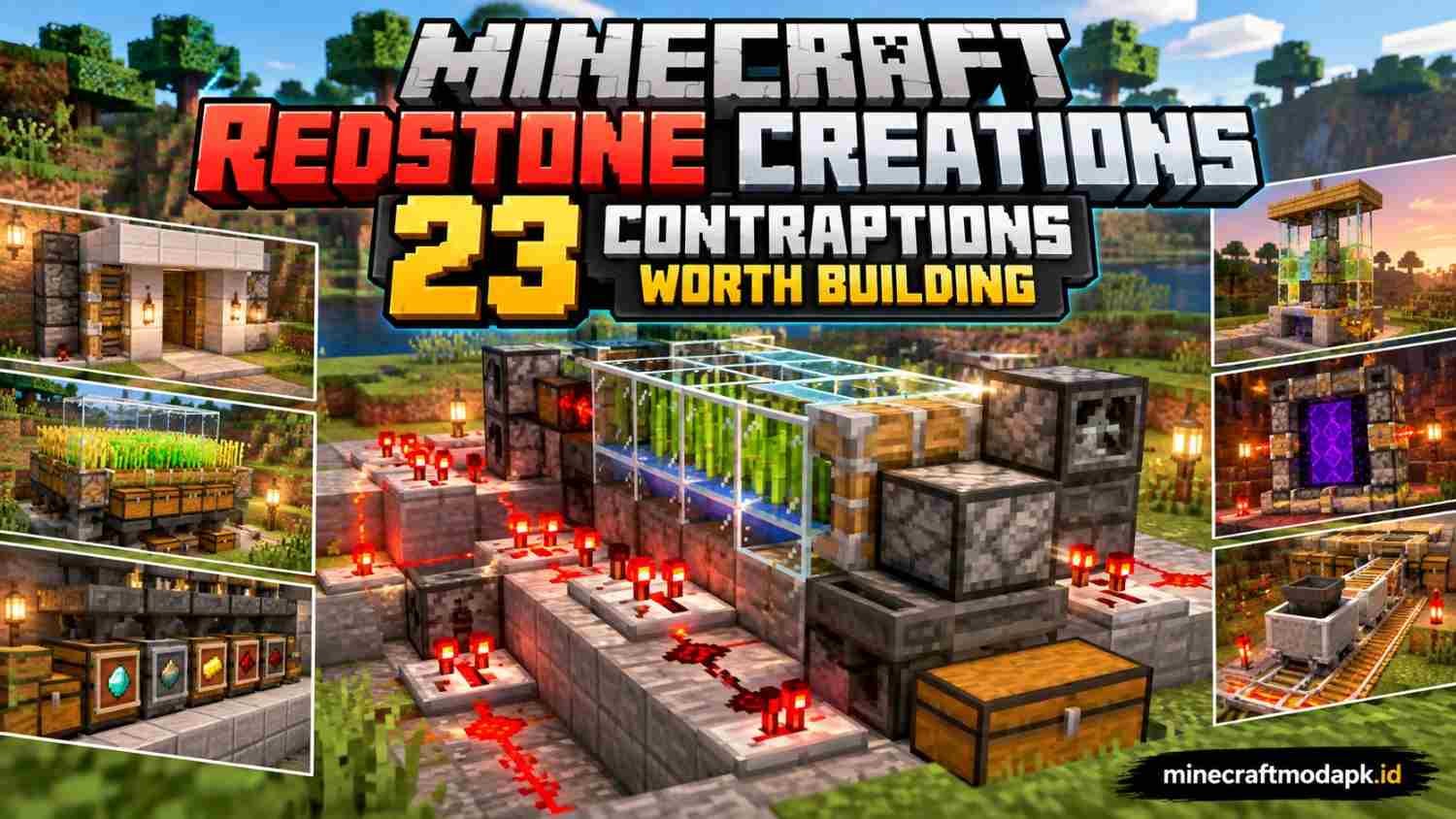
Minecraft Redstone Creations 23 Contraptions Worth Building
Minecraft redstone creations stop being a novelty once your base starts running itself. I worked through this exact list build by build, starting with the simplest circuits and ending with the ones that took a few tries to get right. Each entry below lists the parts and the numbers that made it work.
You’ll get 23 builds plus a bonus timer, grouped from easy to advanced: beginner circuits, farms and automation, crafting machines, transportation, and a few advanced contraptions. If you’re new to redstone, follow the order. Each build reuses logic from the one before it, so nothing feels like a wall of wiring.
Quick Answer: Which Redstone Builds Should You Make First?
- Start here: the bedtime chime and the simple piston door. They need no comparators or observers.
- Automate next: the automatic smelter (3 hoppers per furnace) and the auto equip armor tunnel (1 pressure plate, 4 dispensers).
- Learn comparators: the wool item sorter unlocks at signal strength 3, which took 46 wool in its hopper.
- Then crafting: the bulk crafter fires at signal strength 9, reached with two stacks plus 55 items in the hopper.
- Save for last: shulker box loaders. A completely full shulker box reads 15, the maximum signal strength.
- Edition check: the flying machine here needs a Java-only piston behavior, so Bedrock players should skip it or use a different design.
Quick Facts
| Category | Detail |
| Total builds | 23, plus one bonus timer circuit |
| Difficulty range | Beginner (bedtime chime) to advanced (shulker box loader) |
| Core components | Comparators, observers, hoppers, dispensers, target blocks, powered rails |
| Key measurement | Signal strength, from 0 to 15 |
| Edition note | Most builds work on Java and Bedrock. The flying machine and the gravity elevator rely on Java-only mechanics |
| Best game mode | Survival or Creative |
Why These Redstone Builds Matter
Every build here does one of three things: saves you time, moves you around faster, or crafts something so you’re not stuck at a table. Once the comparator and observer logic behind a few of them clicks, you’ll start reading the rest on sight.
Types of Builds Covered
- Beginner circuits: quick wins with one power source.
- Farms and automation: smelting, sorting and crop harvesting.
- Crafting machines: crafters that run from comparator signals.
- Transportation: elevators, bubble columns and minecart stations.
- Advanced contraptions: clever tricks like flying machines and shulker box loaders.
Materials and Requirements
Main components: redstone dust, torches, repeaters, comparators, observers, target blocks, hoppers, dispensers, droppers, pistons, sticky pistons, powered rails, redstone blocks.
Farm extras: cauldrons, fence posts, mud blocks (so hoppers can collect through a block), waterlogged leaves, jack o’lanterns, note blocks.
Transportation extras: slime blocks, honey blocks, iron trapdoors, hay bales, soul sand, magma blocks, ender pearls.
Pricier or optional items:
| Item | Why it costs more | Needed for |
| Shulker boxes | Shells only drop from shulkers in End cities | Shulker box loader and unloader |
| Slime blocks | Need slime farming or swamp hunting | Bubble column and honey block elevator |
| Nether quartz | Needs a Nether trip; every comparator uses 1 | Every comparator build |
| Ender pearls | Need Enderman farming or trading | Stasis chamber teleporter |
Tip: Gather quartz before you start. Nearly half this list uses a comparator, and running out mid-build is the most common reason people stall.
Planning Before You Build
Most of these circuits come down to one question: what signal strength does the comparator read, and at what number does something switch? Know that trigger number before placing blocks.
- The wool sorter unlocks at signal strength 3.
- The bulk crafter needs signal strength 9.
- A full shulker box reads 15.
If the item count is wrong, the machine won’t move, and it will look like a wiring problem when it isn’t.
Also decide early which builds you can use. The flying machine and the gravity elevator depend on Java-only mechanics, so Bedrock players should test them in a throwaway world first.
Easy Redstone Builds for Minecraft Beginners

These five teach the basics: how power travels, which way dust points, and how a single input can trigger several outputs.
1. Bedtime Chime
Difficulty: Easy Materials: 1 daylight detector, 4 redstone dust, 1 note block or bell
- Right-click the daylight detector to switch it to night mode.
- Run 4 redstone dust from it to a note block or bell.
The chime sounds as soon as it’s dark enough to sleep.
2. Simple Piston Door
Difficulty: Easy Materials: 2 pistons, 2 wall blocks, redstone dust, 1 power source
- Stack two pistons with a block in front of each.
- Power the bottom piston from a solid block behind it.
- Power the top piston with redstone dust pointed directly at it.
Visual check: If the bottom piston extends but the top one doesn’t, the dust isn’t facing the top piston. This is the first mistake almost everyone makes with redstone.
3. Toggleable Nether Portal
Difficulty: Intermediate Materials: 1 dispenser with fire charges, 1 dispenser with a water bucket, observers, redstone dust, 1 button
- Aim a dispenser loaded with fire charges at the portal frame. Fire it once to light the portal.
- Aim a second dispenser holding a water bucket at the portal.
- Wire a button through observers watching a piece of redstone dust, so pressing and releasing send two separate signals. The first places the water, and the second pulls it back into the bucket.
Important: This only works in the Overworld. Water evaporates instantly in the Nether, so the extinguish step can’t work on a Nether-side portal. There, use a different closing method, such as a piston that removes a frame block.
Visual check: Afterward, the dispenser should hold its water bucket again. If you’re in the Nether and the water never appears, that’s evaporation, not a wiring mistake.
4. Enchanter Shuffler
Difficulty: Intermediate Materials: target blocks, redstone dust, pistons, bookshelves already in place
- Wire redstone dust into target blocks that control pistons under your bookshelves.
- Use the pistons to raise or lower blocks that hide or expose each shelf.
- Change how many shelves the table can see, and check the offers at each count.
Each bookshelf count shows its own set of offers, so the shuffler lets you compare several options without breaking anything. Going back to a count you’ve already seen shows the same offers again. The whole set only changes after you enchant an item (how enchanting offers work).
5. Auto Equip Armor Tunnel
Difficulty: Easy Materials: 1 pressure plate, 4 dispensers, 1 full set of armor
- Place 4 dispensers around one pressure plate, one per armor slot.
- Load each dispenser with its matching piece.
- Step on the plate. All four fire at once.
Build a row of these stations and you have an equip tunnel to run through before heading out.
Automatic Farms and Practical Redstone Builds
This is where redstone starts saving real time. Most of these run with no input from you once they’re built.
6. Automatic Smelter
Difficulty: Easy Materials: 1 furnace, 3 hoppers, 1 chest
- Top hopper: raw items into the furnace’s top slot.
- Side hopper: fuel into the side slot.
- Bottom hopper: pulls smelted items out into a chest.
Tip: Crouch while placing each hopper, or you’ll open the furnace instead of attaching to it.
7. Automatic Dropper Circuit
Difficulty: Intermediate Materials: 1 dropper, 1 comparator, 1 repeater, redstone dust
- Place a comparator reading the dropper’s contents.
- Route its signal through a repeater and back into the dropper.
The repeater fires the dropper, which briefly turns the comparator off and resets the loop. It keeps firing on its own while the dropper has items.
8. Automatic Item Sorter (Wool Example)
Difficulty: Intermediate Materials: hopper line, 1 branch hopper, 1 redstone torch, 1 comparator, 1 barrel
- Run a horizontal hopper line so items travel across it.
- Under the spot for your filtered item (white wool here), add a branch hopper leading into a barrel.
- Lock that branch hopper with a redstone torch.
- Wire a comparator from the branch hopper. When it holds enough wool, the comparator’s signal turns the torch off, unlocking the hopper so one item drops through.
In this build, the branch hopper needed 46 wool before the comparator reached signal strength 3, enough to switch the torch. Everything else keeps moving down the line, since only wool stacks in that hopper.
Tip: If the sorter lets everything through or nothing through, count the items in the branch hopper before touching the wiring.
9. Automatic Cooked Chicken Farm
Difficulty: Easy Materials: 1 cauldron, lava, 1 fence post, hoppers, a flock of chickens
- Fill a cauldron with lava. A lava cauldron burns any mob that ends up inside it.
- Place a fence post beside it, positioned so baby chickens get pushed into the cauldron as they grow.
- Put hoppers underneath to collect the cooked chicken.
- Keep a flock of egg-laying chickens nearby to supply it.
10. Melon and Pumpkin Farm
Difficulty: Easy Materials: 4 stems, 1 mud block, 1 observer, 1 downward-facing piston, hoppers
- Plant 4 stems around one open block, the only spot the fruit can grow.
- Put a mud block on that spot. Fruit can grow on mud, and hoppers below can collect drops through it.
- Point an observer at the spot, wired to a downward-facing piston above it.
The moment a melon or pumpkin appears, the observer fires and the piston breaks it into the hoppers.
11. Sugarcane and Bamboo Farm
Difficulty: Easy Materials: observer, piston, mud block, waterlogged blocks, jack o’lanterns, 1 note block per slice
- Use the melon farm’s observer-and-piston setup, turned to face the stalk.
- Plant on a mud block so hoppers underneath can collect.
- Place waterlogged blocks next to the planting spot. Sugar cane accepts them as its water source.
- Add jack o’lanterns for the bamboo. Sugar cane grows in any light level, so it doesn’t need them.
- Put a note block between piston slices so neighboring slices don’t trigger each other.
Redstone Crafting Machines Worth Automating
Crafters turn comparator logic into finished items. Build the bulk crafter first. It’s the simplest, and it teaches the idea behind the other two.
12. Rocket Crafter
Difficulty: Advanced Materials: 2 crafters, 1 gunpowder hopper, 1 sugarcane hopper, 2 comparators, torches, 1 shared hopper
- Feed gunpowder into one hopper and sugarcane into another, each read by its own comparator.
- Route both signals into torches so the timer only starts when both hoppers have items.
- Set crafter one to turn sugarcane into paper.
- Set crafter two to turn paper and gunpowder into rockets.
- Link them with a shared hopper that passes the paper across.
It doesn’t jam, because it only crafts when both ingredients are actually in stock.
13. Automatic Torch Crafter
Difficulty: Advanced Materials: 1 crafter, 1 sticks hopper, 1 coal hopper, 2 comparators, 1 sticky piston, 1 repeater, 1 upward-facing observer
- Feed sticks and coal into separate hoppers, each read by a comparator wired into the crafter.
- Add a sticky piston powered through a repeater.
- Add an upward-facing observer that notices when torches are taken.
The machine refills back to the same stock level without overflowing.
14. Bulk Crafter (Single Ingredient)
Difficulty: Intermediate Materials: 1 crafter, 1 input hopper, 1 comparator
- Feed your raw material into an input hopper.
- Place a comparator reading that hopper into the side of the crafter.
- Set the recipe to any single-ingredient craft, such as iron ingots into iron blocks.
This build needed signal strength 9 on the side, reached with two full stacks plus 55 items in the hopper. Change the recipe and the same rig works for any single-ingredient craft.
Redstone Transportation and Elevator Builds
Now that you can build logic, use it to move yourself and your items around.
15. Switchable Bubble Column
Difficulty: Easy Materials: magma block, soul sand, slime blocks, 1 sticky piston
- Place a magma block and soul sand side by side on slime blocks.
- Attach a sticky piston so it slides them back and forth.
- Toggle the piston to swap which block sits under the water column.
Soul sand pushes you up and magma pulls you down, so one switch reverses the bubbles instantly.
16. Multi-Floor Honey Block Elevator
Difficulty: Intermediate Materials: honey blocks, 1 bubble column, 1 iron trapdoor and 1 button per floor
- Line a shaft with honey blocks, slightly narrower than normal.
- Wedge a bubble column into one corner.
- At each floor, add an iron trapdoor and a button.
Press the button to let the trapdoor pass you upward, or leave it closed to stop at that level.
17. Gravity Elevator (Downward)
Difficulty: Intermediate Materials: 1 torch, 1 sticky piston, 1 hay bale, per-floor button setup Edition: Its compact wiring relies on quasi-connectivity, which is Java only.
- Reuse the per-floor button setup from the honey elevator.
- Wire a torch to a sticky piston that slides a hay bale in and out of the drop path.
- Land on the hay bale to cut fall damage.
Tip: Check that the bale is in place before you drop, not sliding in mid-fall.
18. Ender Pearl Stasis Chamber Teleporter
Difficulty: Advanced Materials: 1 daylight sensor, 1 comparator, 1 repeater, 1 trapdoor, redstone dust
- Set a daylight sensor and a comparator so their signals race each other through a delayed repeater.
- Connect the output to the trapdoor of your pearl stasis chamber.
- Sleep only when most of the visible clock has turned dark.
Timed right, the sudden nightfall signal beats the repeater’s delayed lock and flips the trapdoor, teleporting you back. If it doesn’t fire, you most likely slept too early.
This circuit is adapted from a build by BRUN, a smaller YouTube creator credited in the original video this guide is based on.
19. Minecart Loader
Difficulty: Intermediate Materials: 1 comparator, 1 torch, 1 repeater, 1 powered rail, loading hopper
- Place a comparator reading the loading hopper.
- Wire it so any items in the hopper switch off a torch, a repeater and the powered rail.
With the rail off, the minecart waits. Once loading finishes, the rail powers on and sends it along.
20. Minecart Unloader
Difficulty: Intermediate Materials: 1 comparator, 1 powered rail, unloading hoppers
- Place a comparator reading the minecart’s container as it arrives.
- Invert that signal into the powered rail.
The rail stays off while the cart holds items, and powers on to release it once it’s empty.
Advanced Redstone Contraptions
These last three combine everything above: pulses, observers and comparator thresholds. Build them once the earlier sections feel easy.
21. Basic Flying Machine
Difficulty: Advanced Materials: 2 sticky pistons, 1 observer Edition: Java only
- Give a sticky piston a one-tick redstone pulse. On Java, a pulse that short makes the piston drop the block it pushed instead of pulling it back.
- Add a second sticky piston and an observer facing the first.
- The observer’s own movement pulls the back half forward, and the cycle repeats until the machine hits a block it can’t pass.
Bedrock has flying machines too, but block dropping is Java only, so this exact design won’t run there (flying machine mechanics).
22. Shulker Box Loader
Difficulty: Advanced Materials: 1 input hopper, 1 shulker box, 1 comparator, 1 redstone block, 1 observer, 1 sticky piston, 1 storage chest, 1 dispenser loaded with empty shulker boxes
- Feed items through a hopper into an empty shulker box.
- Place a comparator watching for signal strength 15, which means the box is completely full.
- Offset it with a redstone block so the resting reading sits at 14.
- When the reading jumps to 15, an observer triggers a sticky piston that breaks the full box into the storage chest.
- As the piston retracts, the dispenser places a fresh empty box.
Tip: Test the loader with one box before loading the dispenser with a full stack.
23. Shulker Box Unloader
Difficulty: Advanced Materials: loading hoppers, 1 dispenser, 1 unloading hopper, 1 comparator, 1 torch, 2 pistons, 1 redstone block
- Feed full shulker boxes through hoppers into a dispenser aimed at an empty spot.
- A hopper below slowly pulls the items out of the placed box.
- When the box is empty, a comparator activates a torch that runs a short piston sequence to break it.
- As the circuit resets, the dispenser places the next full box.
Bonus: Etho Hopper Clock
Difficulty: Advanced
A fully adjustable redstone timer for anywhere you need a custom interval instead of a fixed one. It has enough depth for its own walkthrough, so treat it as the next thing to learn once everything above feels comfortable.
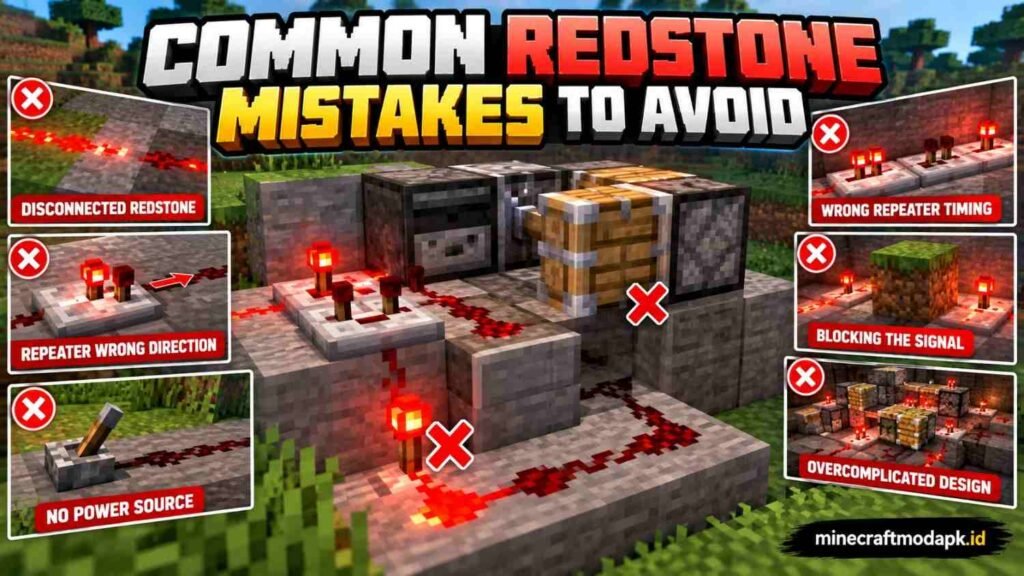
Common Redstone Mistakes to Avoid
The top piston in a piston door doesn’t extend.
- Why: The redstone dust isn’t pointed directly at it.
- Fix: Trace the dust block by block and confirm it faces the piston you expect.
Placing a hopper opens the container instead.
- Why: You’re looking straight at the chest or furnace while placing it.
- Fix: Crouch every time you place a hopper next to a container.
The Nether portal’s water step does nothing.
- Why: You built it in the Nether, where water evaporates instantly.
- Fix: Build this version in the Overworld, or use a piston-based closing method.
The ender pearl teleporter doesn’t fire.
- Why: You slept too early, or didn’t sleep at all.
- Fix: Wait until most of the visible clock is dark before sleeping.
A bulk crafter or torch crafter won’t start.
- Why: The input hopper hasn’t reached the signal strength the comparator needs.
- Fix: Check the item count against the required signal strength before rewiring anything.
The enchanter shuffler keeps showing the same offers.
- Why: Offers only change when the bookshelf count changes, or after you enchant an item.
- Fix: Compare different shelf counts, or enchant something cheap to get a completely new set.
Frequently Asked Questions
What is the easiest Minecraft redstone build to start with?
The bedtime chime or the simple piston door. Both use one power source and a short line of dust, and neither needs comparators or observers.
How does the automatic item sorter know when to release an item?
A comparator reads how full the branch hopper is. In this wool sorter, it took 46 items to reach signal strength 3, which switched off the torch locking the hopper.
Can I fully automate crafting in Minecraft?
Yes. Crafters paired with comparators reading your ingredient hoppers can run on their own. This list covers a rocket crafter, a torch crafter and a bulk crafter.
Do flying machines work on Bedrock Edition?
Bedrock has flying machines, but this design relies on Java’s block dropping, where a one-tick pulse makes a sticky piston release its block. It won’t work on Bedrock as written.
Does the toggleable Nether portal work inside the Nether?
Not the water step, because water evaporates in the Nether. Build it in the Overworld, or use a piston-based closing method on the Nether side.
How does a shulker box loader know when a box is full?
A comparator reading a completely full shulker box outputs signal strength 15, the maximum.
What is quasi-connectivity, and where is it used here?
It’s a Java-only mechanic that lets pistons, droppers and dispensers be activated by power reaching the block space above them (quasi-connectivity explained). The gravity elevator uses it to keep its wiring compact.
Final Thoughts
Work through these in order. The early builds teach you how a signal moves and how a comparator reads a container, and every later build applies that same logic to a bigger problem. By the time you reach the shulker box loader, you’ll understand why it works instead of just copying block placements.
Ready for more? Try the advanced projects in our redstone builds guide — and if you’re just starting a world, survive your first night first.



One Comment