10 Best Minecraft Biomes to Explore and Build In
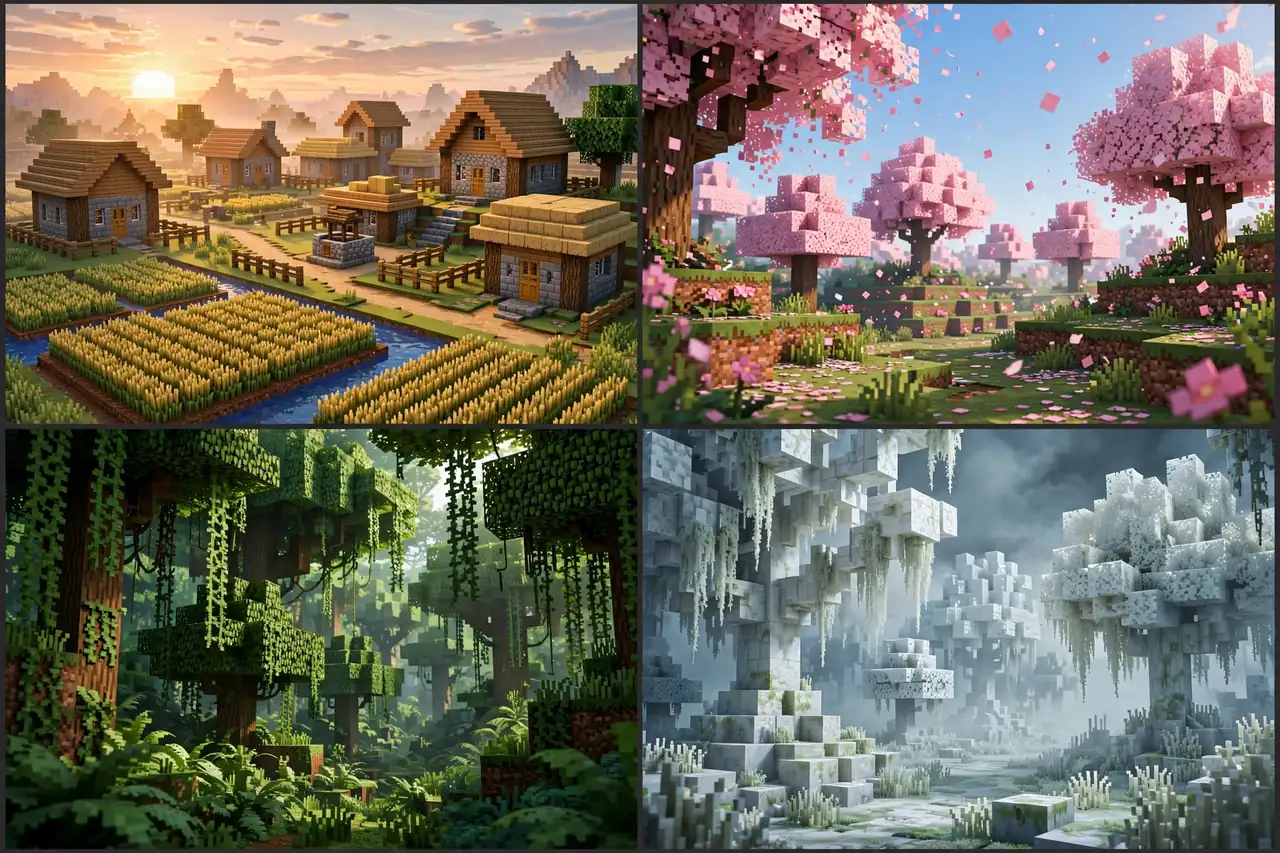
I spent my first real Minecraft world building a base in a jungle, mostly because it looked cool in a video I’d watched. Took me about two days to admit the dense trees and constant ocelot dodging weren’t paying off, and I moved everything to a plains biome instead. That’s the thing about biomes — the best Minecraft biomes depend entirely on what you’re trying to do, not just which one looks the most impressive on a thumbnail. This guide ranks the biomes that actually deliver, organized by what each one does well.
Ranked from direct exploration and base-building across all ten biomes, cross-checked against a fully-fetched top-ranking competitor for scope and format.
On this page: Quick comparison table · Plains · Cherry Grove · Meadow · Jungle · Savanna · Taiga · Mushroom Fields · Badlands · Desert · Pale Garden · What’s new in 2026 · FAQ
Best Minecraft Biomes: Quick Comparison
| Biome | Best For | Key Resources |
|---|---|---|
| Plains | Best overall | Villages, horses, flat terrain |
| Cherry Grove | Best-looking | Cherry wood, bees, pink petals |
| Meadow | Scenic base | Flowers, elevation, mountain views |
| Jungle | Resources | Wood, bamboo, cocoa, melons |
| Savanna | Large flat builds | Acacia wood, horses, llamas, no rain |
| Taiga | Balanced survival | Spruce, sweet berries, wolves |
| Mushroom Fields | Safety | Mooshrooms, no hostile spawns |
| Badlands | Gold | Gold ore, terracotta, mineshafts |
| Desert | Loot | Temples, villages, camels |
| Pale Garden | Eerie builds | Resin, eyeblossoms, the Creaking |
1. Plains — Best Overall Biome
Not sure where to settle? Default to Plains. The terrain is flat enough that you can start building the moment you land, with none of the tree-clearing or leveling other biomes demand. Villages tend to show up close by, which means trades, beds, and food are sorted almost immediately instead of something you have to work toward. Horses and donkeys wander the grass too, so transport stops being a problem in the first few days rather than the first few weeks.
There’s a reason Plains tops almost every ranking of the best Minecraft biomes for beginners — it front-loads the easy parts of survival so you can spend your time on things that matter more.
2. Cherry Grove — Best-Looking Biome
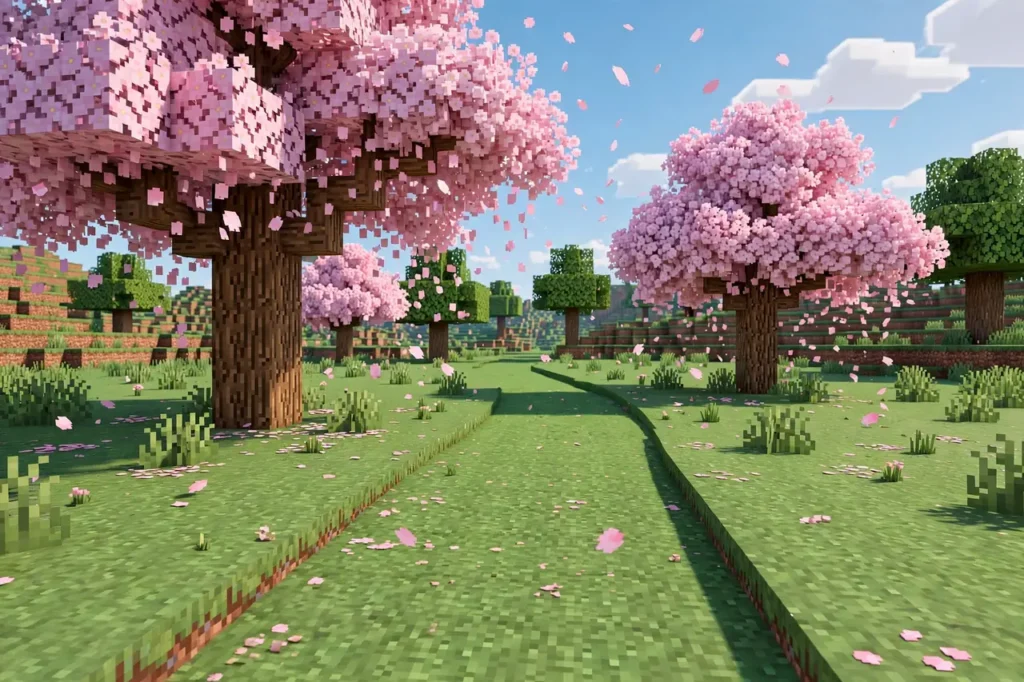
Cherry Grove exists mainly to be looked at. The trees constantly shed pink petals, drifting down over a color palette that nothing else in the game touches — soft pink against green, instead of the usual brown-and-green vanilla look. Cherry wood gives you planks, doors, and stairs in that same rosy tone, which is basically impossible to replicate by dyeing anything else.
It’s not purely decorative, either. Bees, pigs, and sheep still spawn here, so a Cherry Grove base functions fine day to day. If the goal is a build people stop to screenshot, this is one of the best Minecraft biomes for the job.
3. Meadow — Best Scenic Base Location
Meadows generate high up on mountainsides, and the elevation is the whole selling point. You get a calmer bluish-green grass color, flowers scattered everywhere, and a view down over whatever terrain surrounds you — something almost no lowland biome can offer. Being up high also tends to keep hostile mobs at more of a distance than you’d get down at sea level.
Villages and pillager outposts show up here occasionally too. Anyone picturing a castle or cottage overlooking a valley should be building in a Meadow specifically, not just any hill.
4. Jungle — Best for Resources
Nothing outpaces a jungle for raw material output. The sheer density of trees means wood is never a concern, and it’s the only place you’ll reliably find bamboo and cocoa beans growing naturally. Melons show up too, and jungle temples occasionally hide loot along with the odd enchanted book.
The downside is that building here takes patience — the terrain is uneven, trees crowd every angle, and clearing space costs more time than almost anywhere else on this list. Best treated as a place you raid for supplies rather than somewhere you live full-time, at least early on — which is still enough to earn it a place among the best Minecraft biomes for resource runs.
5. Savanna — Best for Large Flat Builds
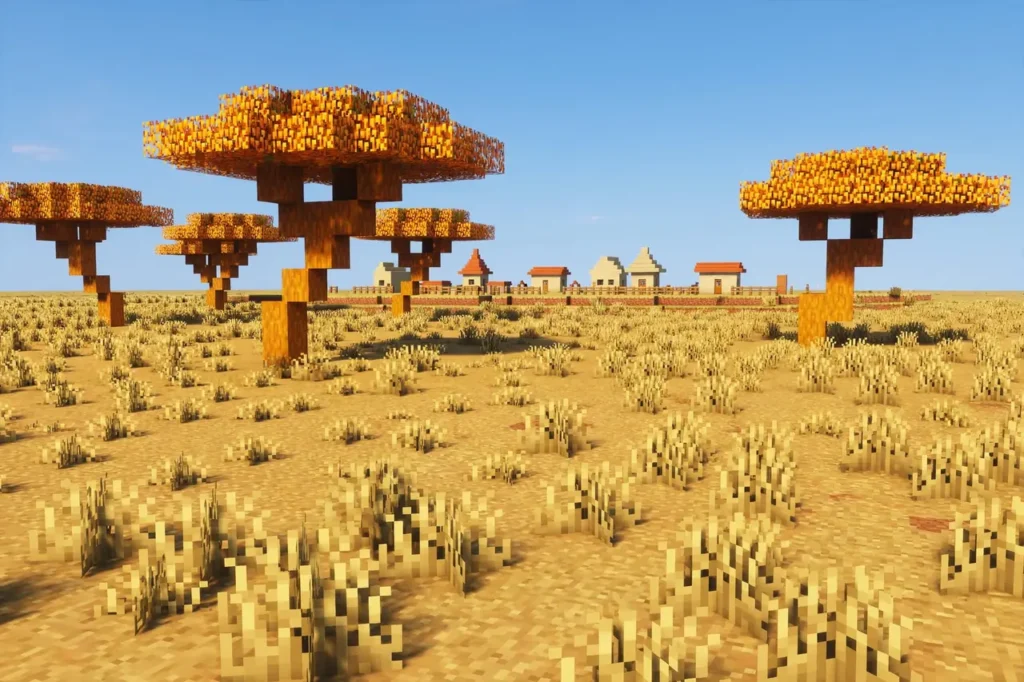
Savanna shares the flatness of Plains but adds a specific advantage: it never rains here. No thunderstorms pausing your farms, no delayed builds waiting out weather. Orange acacia trees and dry gold grass give it more personality than a plain grass field, and villages, horses, and llamas all turn up regularly.
For anything large-scale — a full town, a sprawling farm setup — the combination of flat ground and predictable weather makes Savanna one of the best Minecraft biomes for large-scale building once you’re past the early game.
6. Taiga — Best Balanced Survival Biome
Taiga is the biome that never fails at anything without ever being the best at anything either, and that balance is exactly why it works so well as a long-term home. Spruce trees keep your wood supply steady, sweet berry bushes give you a renewable food source without any farming setup, and wolves spawning here can be tamed into companions that’ll follow you through combat. Foxes and small villages round out the package, and the Old Growth Taiga variant throws in giant spruce trees that are a solid destination on their own.
Trees give you enough shelter that you’re never as exposed as you’d be in Plains, but it’s nowhere near the tangled mess a jungle turns into. Underneath, there’s usually solid cave access for mining too. If you had to pick one biome to just live in and not think too hard about, this is probably it.
7. Mushroom Fields — Safest Biome in the Game
There’s exactly one reason to care about Mushroom Fields, but it’s a big one: natural hostile mob spawning doesn’t happen here, including underground. A couple of edge cases still apply — mob spawners inside generated structures like mineshafts still function normally, and phantoms can still appear if you go too long without sleeping, since that mechanic isn’t tied to biome at all. Outside of those exceptions, this is as close to guaranteed safety as Minecraft gets. For anyone playing Hardcore mode — where a single death ends the entire world — that makes this the only biome where you can actually let your guard down.
Mooshrooms wander around freely, and a single one can supply you with milk, mushroom stew, and beef indefinitely, so food stops being something you manage at all. The catch is that Mushroom Fields are one of the rarer biomes in the game, usually sitting as an isolated island somewhere in the ocean, so you’re more likely to stumble onto one by exploring than by heading toward it directly. Once you’re there, though, it’s close to the least stressful way to survive that Minecraft offers, which is why it still ranks among the best Minecraft biomes for cautious players despite being so hard to find.
8. Badlands — Best Biome for Gold
Badlands, sometimes called Mesa, stands out visually with its orange-and-red terracotta layers, but the reason it makes this list is underneath: gold generates at a noticeably higher rate here than in any other biome, often close enough to the surface that you can mine it without the usual deep strip-mining trip.
The layered terracotta itself is popular for building thanks to its color range, and abandoned mineshafts frequently poke out of the surface here instead of staying buried. Food and wood are both scarce, so this works better as a mining destination you visit than a biome you’d want as home base.
9. Desert — Best Biome for Loot
Deserts don’t look like much at first glance, but they’re a strong early-game loot destination. Desert temples hold chests that reward the trip (watch for the hidden TNT trap underneath one of the loot rooms), villages here come with camels as a bonus over standard village trades, and the flat sand makes construction simple.
The tradeoff is food — rabbits and camels are the only animals that spawn naturally, so you’ll want to bring supplies or set up a farm if you’re sticking around. Approach this one as a place to raid and trade, not somewhere to build a permanent home.
10. Pale Garden — Best for Eerie, Unique Builds
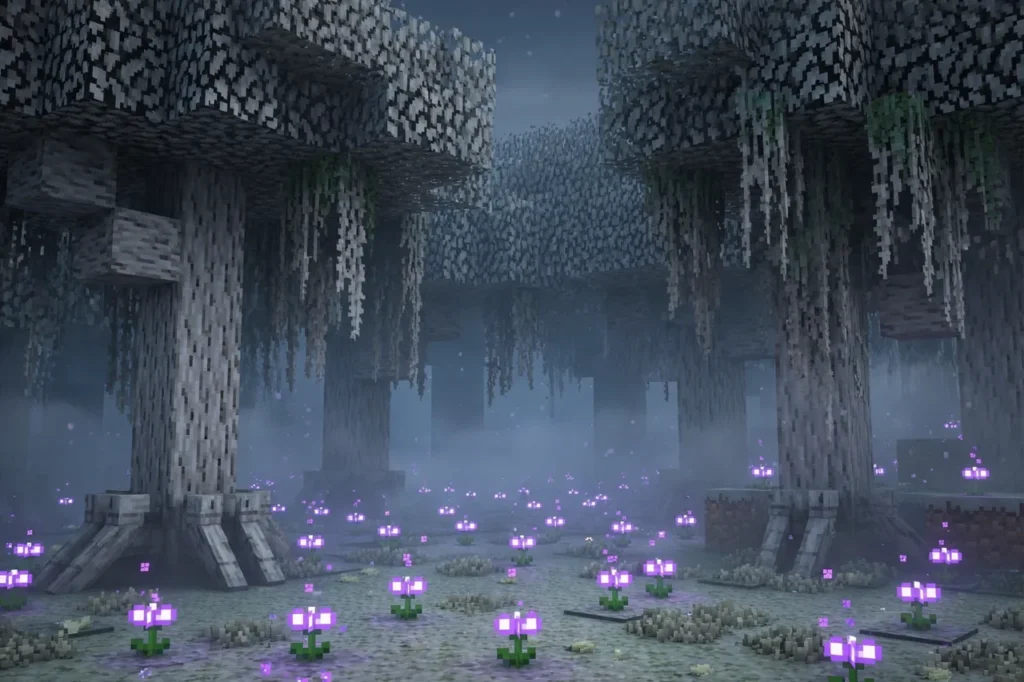
Pale Garden is the newest classic-style biome on this list, and it’s also Minecraft’s first attempt at a true horror aesthetic. Pale, bone-white oak trees hang with moss, glowing eyeblossoms dot the undergrowth, and no passive animals spawn at all — the silence itself is part of the effect.
The Creaking lives here, a mob that stays frozen the instant you look at it and only moves when your back is turned. It’s tied to Creaking Heart blocks hidden inside certain pale oaks, which drop resin used to craft an entire set of resin-based blocks. Living here full-time is a challenge, but for a build meant to feel unsettling, nothing else in the game comes close — easily one of the best Minecraft biomes for atmosphere-driven builds.
What’s New in 2026
Two biomes to know about if you haven’t played in a while: the Sulfur Caves, added underground in the Chaos Cubed update (26.2, June 2026), packed with sulfur and cinnabar blocks and home to the new Sulfur Cube mob, and the Dappled Forest, an autumn-themed biome announced at Minecraft Live 2026 and still working through snapshots ahead of a full release. Neither cracked this ranking of the best Minecraft biomes, since they’re built more around specific mechanics and resources than as general base locations, but both are still interesting to explore.
Frequently Asked Questions
What is the best biome in Minecraft?
Plains is the best overall pick for most players — flat, easy to build on, and full of villages, horses, and food sources. For looks specifically, Cherry Grove and Meadow are the strongest picks among the best Minecraft biomes.
What is the safest biome in Minecraft?
Mushroom Fields. Natural hostile mob spawning doesn’t happen here, even underground (structure-based spawners and phantoms from sleep deprivation are the only exceptions), which makes it the top choice for Hardcore worlds.
Which biome has the most resources?
Jungle offers the most surface-level variety — wood, bamboo, cocoa, and melons, plus jungle temples. For ore specifically, Badlands is stronger thanks to its unusually high gold concentration.
What is the rarest biome in Minecraft?
Mushroom Fields is among the rarest Overworld biomes you’ll find on any list of the best Minecraft biomes, generating almost exclusively as isolated ocean islands. Pale Garden is also uncommon, appearing only as a rare variant within dark forests.
What’s the newest Minecraft biome?
As of 2026, Sulfur Caves (added in the 26.2 Chaos Cubed update) is the newest fully released biome, with the Dappled Forest still working through snapshots ahead of a stable release.
Final Thoughts on the Best Minecraft Biomes
I still miss the way that jungle base looked, honestly — the canopy, the waterfalls, all of it. I just don’t miss the two hours I spent clearing trees every time I wanted to add a room. Most experienced players ranking the best Minecraft biomes end up building near a Plains, Meadow, or Savanna for exactly that reason, then take supply trips into Jungles, Badlands, and Deserts for whatever those biomes do best. Pick your home base for practicality, and save the dramatic biomes for the places you visit, not the place you have to maintain.





3 Comments